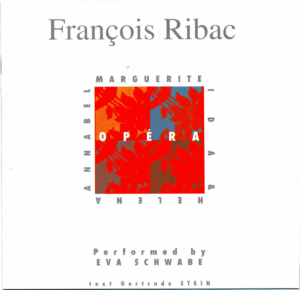
Marguerite Ida and Helena Annabel Opera
François Ribac and Eva Schwabe

François Ribac and Eva Schwabe
No Man’s Land Records
December 1993 – Record Reviews
1 CD No Man’s Land NML 9319 (distributed by Orkhestra)
Recorded in 1992 – Duration: 57 min
ADD – Sound quality: 8
An excellent composer of stage music, Ribac proves with this first chamber opera that he is also one of the most original and promising musicians of his generation. Drawing on the theme of the “double”—Faust/Mephisto — found in Gertrude Stein’s final work, Ida (written in France in 1940), the composer has created an opera for a single character in which the voice alternates between spoken text and singing. Like Weill, Eisler, Berio, Rota, and Ashley, Ribac draws inspiration from popular music, Central European folklore, and jazz, blending them with traditional forms—recitative, cantilena, or fugue…
“The phonetic beauty of the text and the perpetual return to the same themes” allow the composer to vary his stylistic palette and the cohesion of his musical material. The musical numbers flow into one another, multiplying catchy melodies haunted by Stein’s words.
Marguerite Ida Helena Annabel is inextricably linked to the extraordinary personality of Eva Schwabe, who unfailingly strikes the right tone… and handles languages with virtuosity! Her performance was even more impressive during the opera’s Paris run at the Théâtre du Roseau in May 1992, where the performer changed the set herself! François Ribac makes masterful use of electronic keyboard resources—particularly to imitate instruments that were unavailable to him. One would now love to hear this opera in its version (which does exist!) for traditional instruments.
Franck Mallet
March 1994 – Record section
1 CD No Man’s Land NML 9319
Bob Wilson staged the same text by Gertrude Stein, Dr Faustus Lights the Lights, in Germany and then in Gennevilliers with Bernard Sobel. François Ribac’s musical score, about which no information is provided on this disc apart from the composer’s telephone number (sic!), comes to us like a UFO, consisting of a very seductive mixture of repetitive music and barely concealed imitations of Kurt Weill’s best inspirations during his Berlin existence. The acordion is mixed with electro-acoustics in a breathtaking and throbbing perpetual motion in which the names of Marguerite, Ida, Helena and Annabe are repeated. At worst, we find ourselves in cartoons, at best in a very free adaptation of the Faust myth. Choirs intervene while the multi-vocal Eva Schwabe apes Dr Faustus by pinching her nose? She taunts him. From the syncopated rhythm, to the mixture of English and German, to the fusion of current technologies in the service of the German-American cabaret atmosphere of the 20s and 30s. The play on words, repeated or not, is added like a semantic tic that we would have taken from prophetic authors such as Gertrude Stein, already an inspiration for Virgil Thompson.
Playfulness galore, montage of instruments, mixing of telephone sounds, very refined sound effects, this work, this record are as mysterious as they are full of a charm (unevenly diffused) that hardly leaves you. Even if one senses that the author is as much an epigone as an original? A cunning and unusual CD, to be given as a gift, to surprise!
Claude Glayman


 A simple song (No Man’s Land 1995)