


Photos Nina Contini-Melis
Now playing
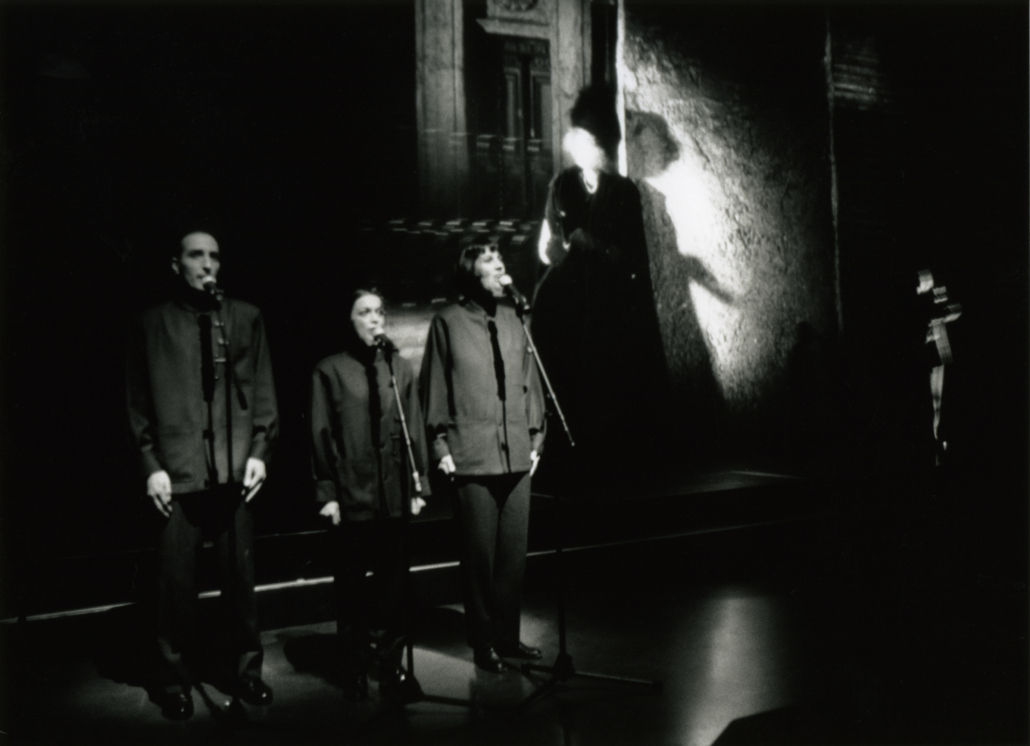
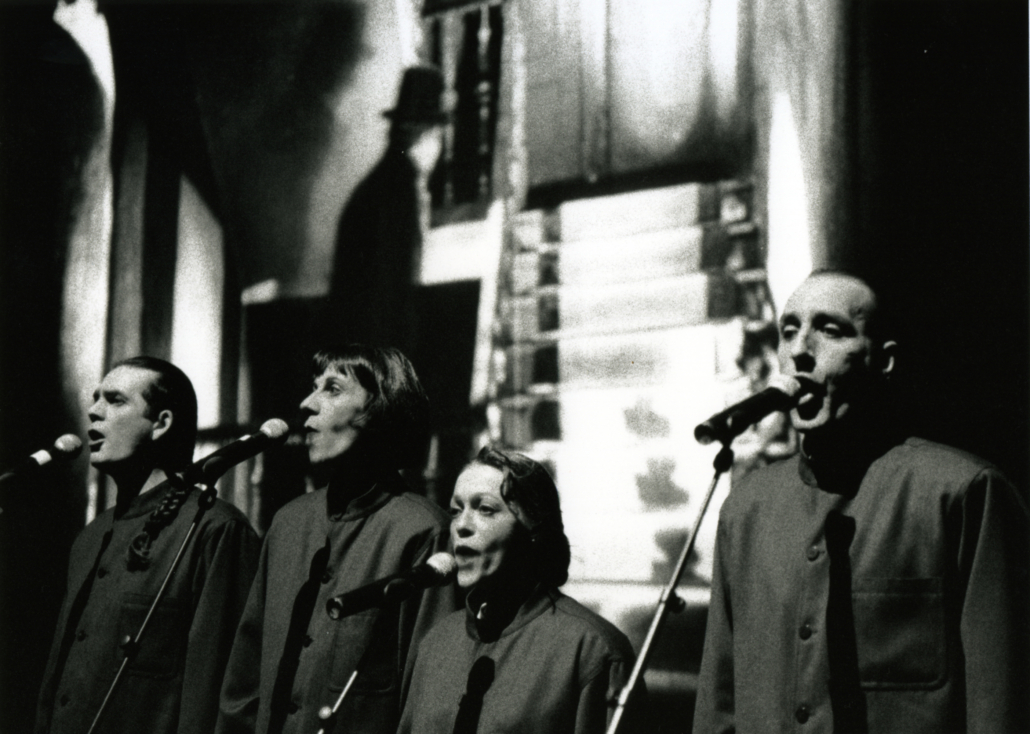
Vocals: Marie Faye, Eva Schwabe, Cyrius Martinez, Frédéric Faye
Sound: Charles Frossard
Instrumental music played on two Revox machines
Kinopéra
Premiered in November 1996 at the Espace Lumières in Epinay sur Seine
An opera for the silent film Die Strasse (1923), four singers and two tape recorders
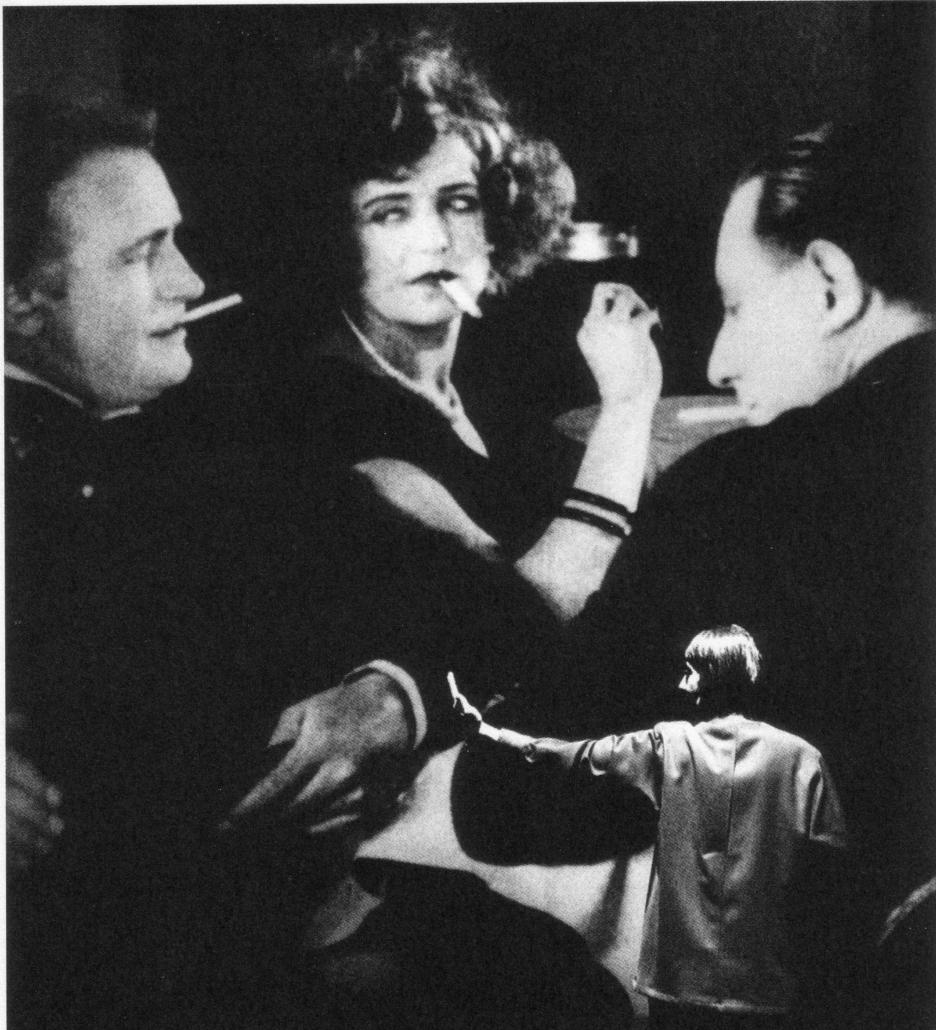
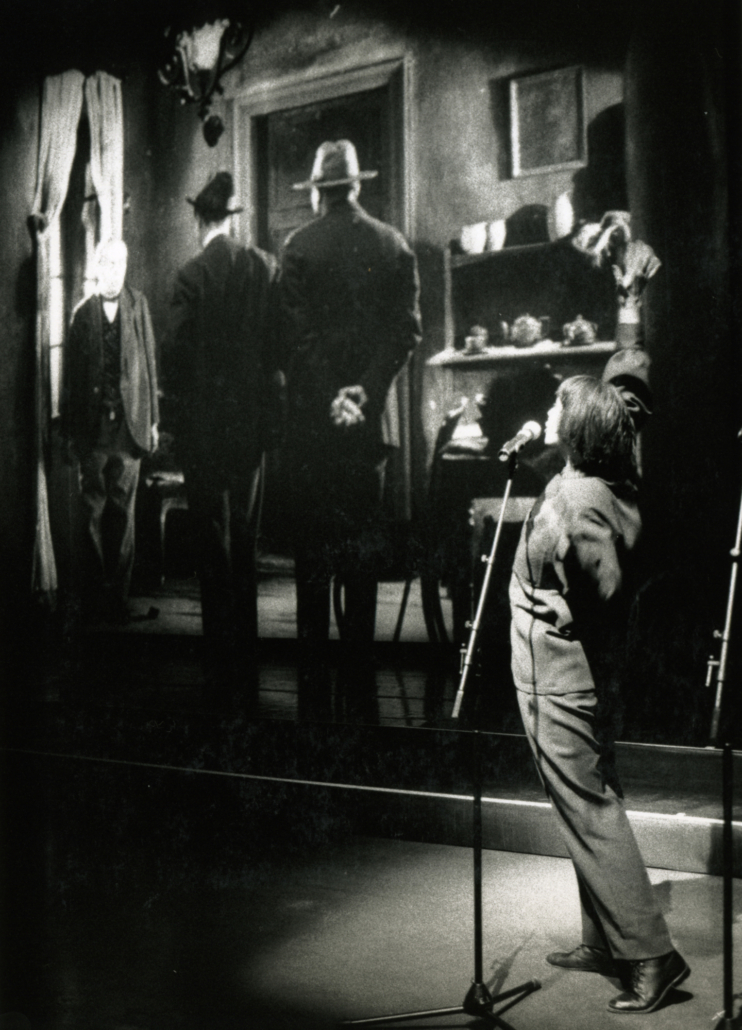
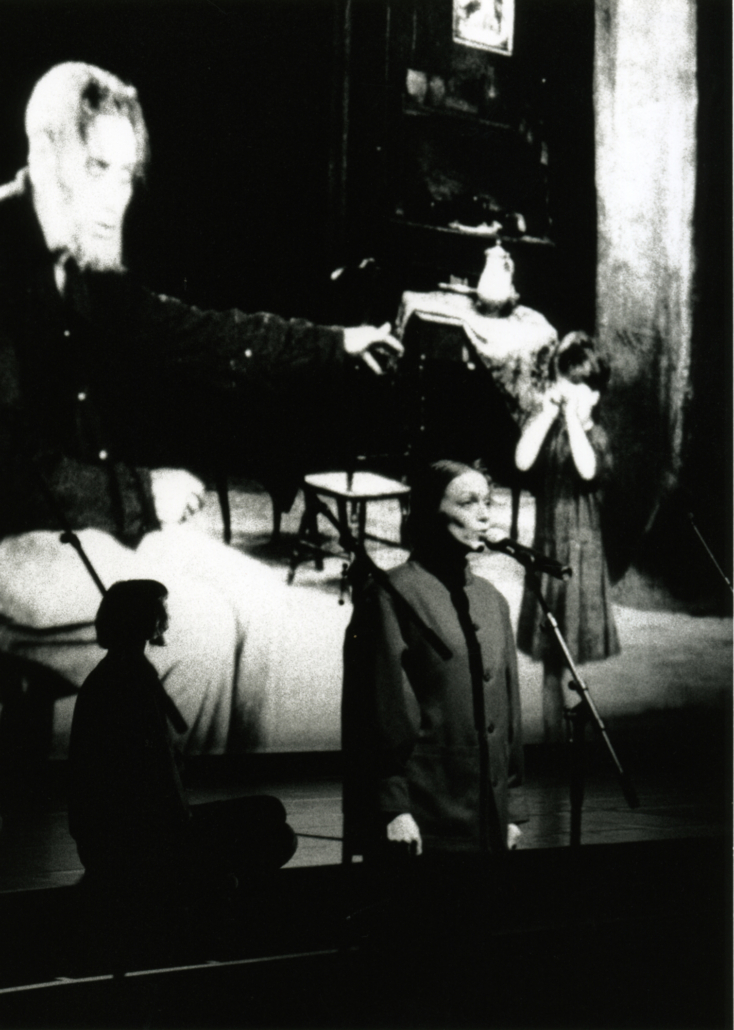
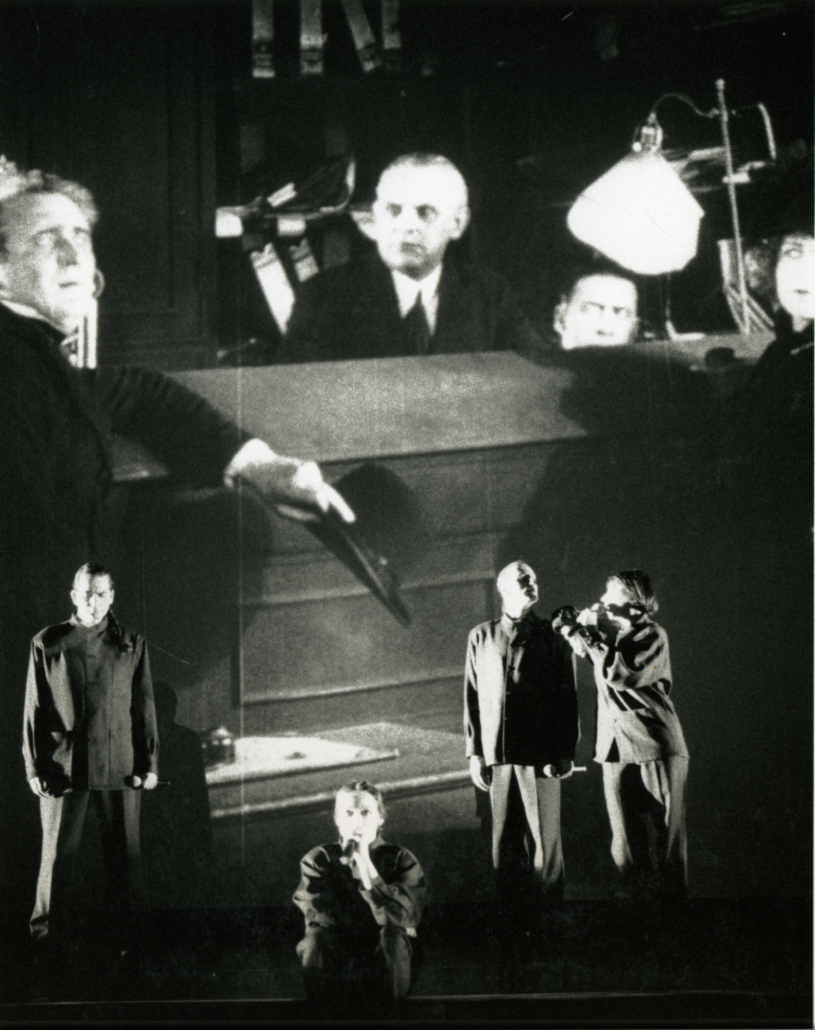
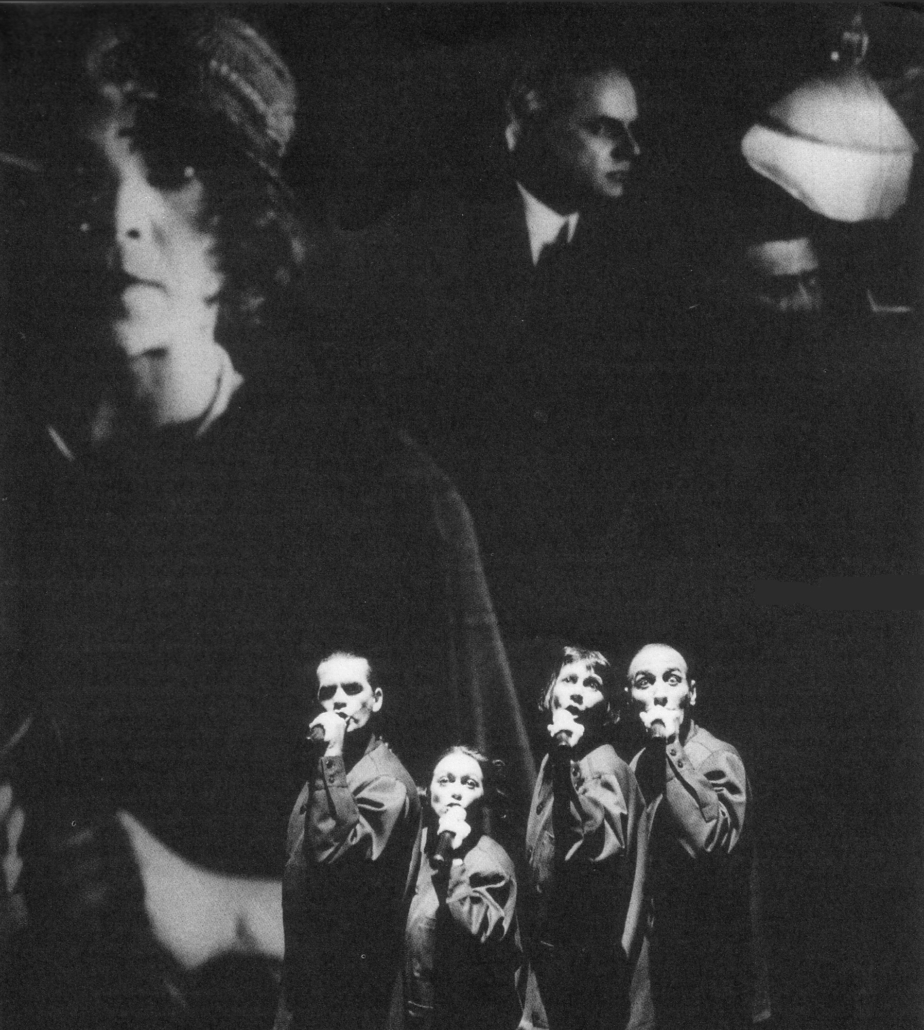
Kinopera draws inspiration from the process known as “film sonore”, a genre that flourished notably in Germany around 1908-09. During the screening of a silent film, a costumed tenor would stand before the screen, attempting to synchronize his lip movements with music played on a concealed gramophone. The repertoire included opera arias, popular songs, and musical parodies that bore no direct relation to the film itself. Inspired by discovering this practice in Siegfried Kracauer’s book From Caligari to Hitler, we conceived the Kinopera project. During screenings of the film Die Strasse 1923, four singers perform a score while acting out the scenes in front of the screen, accompanied by an instrumental track played on two tape recorders.
Filmed in 1923 by Karl Grune, Die Strasse is a silent film classic. Its central theme is the city.
The expressionist imagery in the interiors (huge shadows, the actors’ “sommanbule”) alternates with the exterior scenes, the urban and apocalyptic landscapes. The film is also characterized by a near-total absence of intertitles and by being composed of long sequences. The libretto, mainly in French, is made up of texts by expressionist authors written at the same time as Karl Grune’s film and which evoke the anxiety of big cities, the vertigo poets felt before the new metropolises, and nightlife.
Presse
La lettre du musicien, February 1997
Creation: Kinopéra by François Ribac
The prestigious term “opera” nowadays designates very diverse theatrical and musical productions. Thus, François Ribac’s Kinopéra superimposes cinema on theater, declamation and song, in the distant tradition of silent film accompaniments. Without being an absolute masterpiece, Karl Grune’s film La Rue (1923) offers the interest of a daring treatment of the image. It can be seen as a reservoir of clichés typical of German expressionism: such an aestheticization of the street, the crowd and the city constitutes, within the framework of the “Vive le cinéma” festival organized by the General Council of Seine-Saint-Denis, what is called, in political jargon, a strong signal
The texts gathered by the composer and Eva Schwabe, fourteen poems by German authors plus one by Verhaeren, underline the image and give the film a depth that it might not have on its own.
As for the music itself, which is very skilfully composed, it is only justified in the relationship it has with the show and the staging. Ribac uses techniques from Kurt Weill or Berlin cabaret songs with great imagination and without parody, but also relies on the physical impact produced by repetitive music to maintain a constant dramatic pulse. It must be said that it is well served by a team of singers (Eva Schwabe herself, Marie Grenon, Frédéric Faye and Cyrius) who immediately find the right tone, and by Denis Krief’s staging, which appears very simple, but is very precise in the adjustment of gestures, movements and space.
(Epinay Sur Seine 14 November 1997)
Jacques Bonnaure
Libération, 14 novembre 1996
Kinopéra or expressionism revisited
In the silent film era, there were sometimes fake singers, also mute (with a gramophone in the backstage) and often real musicians, who tried to match their bars to the rhythm of the action – not to mention the soaring lyrical passages. Sound cinema later revisited this tradition (in films like Ragtime and The Sting), starting with Scott Joplin. But here, it would be more like the God Baal or a modern-day Moloch, ruling over the dark industrial cities envisioned by German or Flemish Expressionists.
The starting point is the film The Street(1923), which traces the descent of a petty bourgeois man into the city’s mysteries and fantastical squalor as he follows a prostitute (screened from a new print at the correct speed).
The libretto, written by François Ribac and Eva Schwabe around poems, notably by Verhaeren, is set to music by the former and sung by the latter, surrounded by three other voices. This choir, accompanied by a band, will “play” certain roles in full view of the audience.
This is when we leave the expressionist evocation: around the film, obviously in black and white, the sets, costumes and make-up of the singer-actors will unfold in a style that is “Fauvist,” high-contrast, and colorful.
In other words, it will be a kind of total show or two shows put into perspective, complementing each other. This production by the company Musiques en Scène will go on a national tour after tonight’s performance.
Marc Saint Simon
Frankfurter Allgemeine Zeitung, 21 janvier 1997
When the pictures learned to sing
François Ribac transforms Karl Grune’s silent film Die Strasse into a ” Kinopéra “.
The street has become a film star. In Expressionist literature and cinema, the city street was more than just a place, it was a character in its own right, multifaceted, alluring, devastating. Siegfried Kracauer spoke of “street films”. Karls Grune’s silent film Die Strasse from 1923, for which Ludwig Meidner designed the set, depicts this intrusion of the metropolitan outside world into the interior of the petty-bourgeois living room right from the very first frames. Resting on the sofa, the husband gazes spellbound at the shadows of the colourful street life below dancing across the living room ceiling and can no longer resist the temptation to throw himself into the nocturnal hustle and bustle. Only his wife remains behind, continuing to shut doors and lids on cooking pots upstairs and placing the food in the oven pipe to keep it warm.
From this series of silent film stills, the French composer François Ribac has created a new, original work entitled ” Kinopéra “. Rather than simply writing incidental music to Grune’s film, Ribac has reworked it into a musical divertimento for four singers, performed whilst the film is being projected. The performers act on the front stage as if they had stepped out of the screen. The composer was inspired, among other things, by those “Tonfilm” screenings shortly after 1900, during which, as Kracauer casually reported, a singer stood in front of the screen mouthing the accompanying music played on a gramophone. The texts by Yvan Goll, Erich Mühsam, Georg Trakl, Georg Heym and other authors, which Ribac compiled together with the German singer Eva Schwabe and which deal with the fragmented individual in modern city life, seek more to alienate than to illustrate the respective film scenes. The music played from the tape, which does not deny its echoes of Kurt Weill, draws primarily from the sharply rhythmic stylistic repertoire of the music all, sometimes letting the violins chirp, sometimes letting the percussion intervene or the electric organ waft, and does not disdain individual original sounds such as the clattering of plates or ballroom drums.
The result is a varied, pleasing, mostly fluid music – perhaps a little too fluid when it slips from the Variété of the twenties to that of the seventies. This may well suit Grune’s film, which is on the whole more romantic than expressionistic. However, a little more oblique and shrill counterpoints of dissonance would not have harmed the work. This is partly made up for in Denis Krief’s skilful direction. The angular, exaggeratedly emphatic but at the same time discreetly unobtrusive gestures are clearly copied from Expressionist painting and theatre. At times, the four singers, dressed entirely in black, seem to merge with the screen, at others they stand out sharply against it. With their pieces, sung alternately as soloists and in chorus, they act like film subtitles brought to life: one looks at them and at the same time looks past them.
It’s just a pity that amidst the wealth of impressions the audience misses a great deal and sometimes overhears the lyrics. When Grune’s film in a moralising rush, races towards a happy ending – with the murderer arrested, the child’s innocence proven and the husband back in the living room with his wife – the singers counter with Emile Verhaeren’s poem The City in chorus. Ceaselessly, they sing, the black-clad death creeps through the streets and pushes shadow after shadow in the haze further over the bridge. The production is currently on tour through the Parisian suburbs.
Joseph Hanimann
Jeune Cinéma, november/december 1996
About Kinopera
Take a silent film – Karl Grune’s Die Strasse (1923), a landmark of Expressionism that everyone knows but few have seen – seek out texts to accompany it – from Verhaeren to Georg Trakl and Ivan Goll -, compose a score that suits one and enhances the others, bring together four singers-dancers-actors and entrust a director (Denis Krief) with the task of choreographing a performance to be staged alongside the screening this is what François Ribac has imagined – and called Kinopéra. In doing so, he revisits the old attempts at “total spectacle” in the 1920s, which mixed theatre, ballet and film, and of which we are left with traces such as Eisenstein’s The Diary of Glumov or René Clair’s Entr’acte. A successful endeavour. Presented in a fresh light, dusted off and enhanced by four superb voices La Rue rediscovers a forgotten dimension.
The Kinopéra is touring the Ile-de-France region for several months, performing at Thecif venues. The show is well worth a visit.
Lucien Logette: Why did you choose a classic of expressionist cinema like La Rue?
François Ribac: I am very interested in Germany; I live with a German, Eva Schwabe; I have written two operas that are half in German; I read a lot of German writers from the 1920s and 1930s. One day, while reading Siegfried Kracauer’s book, From Caligari to Hitler, I came across a few lines in which he mentions Oskar Messter and his “sound” films from around 1908, in which a tenor standing in front of the screen pretended to sing along to the music played by a gramophone.
Lucien Logette: At the 1900 Paris World‘s Fair, there was the photo-cinema-theatre. But that’s not quite the same thing Kracauer describes, since he‘s talking about songs and music played at the same time as the film but unrelated to it.
François Ribac: I focused on two ideas, that of a sung music with a relatively tenuous relationship to the images – as far as we know, they were fairground tunes, popular catchphrases, parodies. And on the other hand, the purely operatic aspect of the phonoscenes, which interested me greatly. I dug a little bit into film sound practices; I also began looking into the literature. I found a book by Gert Hofmann, The Cinema Storyteller, the story of his grandfather Carl, a cinema barker, who talks in front of the films and occasionally plays a bit of piano, The Radetsky March accompanying… Caligari. He stands on his little platform holding a cane like a teacher. Not only does he replace the intertitles, but when the actor appears, he says, “That’s Fritz Kortner, he’s already played in three films, do you remember him in so-and-so?” The novel tells of the arrival of the Nazis, and the disappearance of silent film replaced by loudspeakers, the end of a profession. An entire culture is fading away. What interested me about this was the idea of the person speaking in front of the screen who, from outside the film, offers offbeat commentary on it. Since the idea of writing instrumental for a silent film didn‘t interest me, I wanted to compose an opera based on a film.
I looked among historians of German silent cinema for a film that marked the transition to what is known as the New Objectivity. I read several comments about Karl Grune’s The Street. The idea came up to build a libretto using works by Expressionist poets, Constructivists, or even precursors, from which we would try to find texts to illustrate the film‘s themes: fear, the night, prostitutes, the dance hall, and so on… It’s a film that relies a lot on space – on the contradictions between very open and very dark spaces.
Lucien Logette: Let’s go back to the texts. There are poems by Emile Verhaeren and contemporaries and a modern text by Hervé Le Tellier.
François Ribac: Eva Schwabe and I were looking for texts for the different sequences of the film, with different points of view, sometimes directly related: Verhaeren and the “tentacular cities,” for instance—the opening with all those exterior scenes, the accumulation of factories, the frenzy, the metropolis. From time to time, we focused on specific themes: the blind man, the child, and his innocence. Concentrating the vocal writing on one or two characters, I would create the illusion that the character singing was speaking about the inner world of the character visible on screen at that same moment.
Lucien Logette: The only drawback in the Kinopéra production is its richness. You cannot take it all in at once—watching the visuals, listening, and observing the actors. Yet, at a certain point, you simply let yourself be carried along, wanting to see it a second time to grasp all the nuances of its structure.
François Ribac: The idea was to explore all the avenues we had chosen: the epic side, Verhaeren, the cities; the partial identification between the singers and the characters; the point of view of complete exteriority. There is also the idea of the barker, the commentaries, and the idea of having the texts acted and spoken in the film. We even went further, we added sound to the ball scene, when the hero leaves the dance hall and is followed by the two pimps. We added an atmosphere, the sound of plates, conversations and dance music. The character leaves, moves away, and like in a talking film, the sound gradually fades.
Lucien Logette: How long did it take you to work out all the details of Kinopéra?
François Ribac: We came up with the idea about a year and a half ago. First we had to find the film, see if it coincided, read the books and so on. Then came the search for texts. We also conducted visual research—looking at Berlin Expressionist painting and Munich’s Blaue Reiter group, as well as lesser-known artists like Meidner who designed the sets for The Street, and Bauhaus painters, who are not very well known in France, such as Schlemmer and Feininger. We tried to find all the representations of the city from 1910 to 1930: Kirchner, New Objectivity, Constructivism. Initially, we wanted the singers to have an expressionistic look -green faces, painted up like figures in works by Kirchner or Schmidt-Rottluff. When we started rehearsals, we realised that the slightest nuance of colour, even in the stage lighting, made the project look completely kitschy. The film was so powerful that the only option was to eliminate color entirely, even from the lighting design. Consequently, we used only cool and warm whites. Denis Krief’s great achievement in his staging was capturing the characteristic gestures of Berlin—and of Expressionist and Constructivist painting—through the singers’ movements and lighting; he would show the performers specific postures from works by artists like Dix or Kirchner to replicate them.
Lucien Logette: How did you work with the director?
François Ribac: He arrived with a fresh eye and built the core of his work around the text and the score, all while ensuring nothing clashed with the film—yet without attempting to simply follow it. Consequently, the moments where he does amplify the action and aim for total mimicry of the image stand out all the more sharply against the otherwise varied approach.
He also initiated ideas we hadn’t originally considered; it was his concept to have the singers move toward the screen and to play with the interplay of scale and proportion between the performers and the colossal image—whereas initially, we had envisioned nothing more than a small stage in front of the screen with stationary singers.
Lucien Logette: Listening to your music, one cannot help but be struck by the relationship with Kurt Weill. What is your relationship with Brecht?
François Ribac: My training is essentially linked to the theatre, even though I love cinema.
That said, I don’t have a particularly strong relationship with Brecht as a dramatic model. But I do have a deep, openly acknowledged connection to Kurt Weill. That is certain.
Interview by Lucien Logette for the monthly Jeune Cinéma.
Latest news
 16th march 2026 – Some news16 March 2026 - 10h00
 François Ribac 16-03-1961 – 06-11-202415 November 2024 - 11h38

