
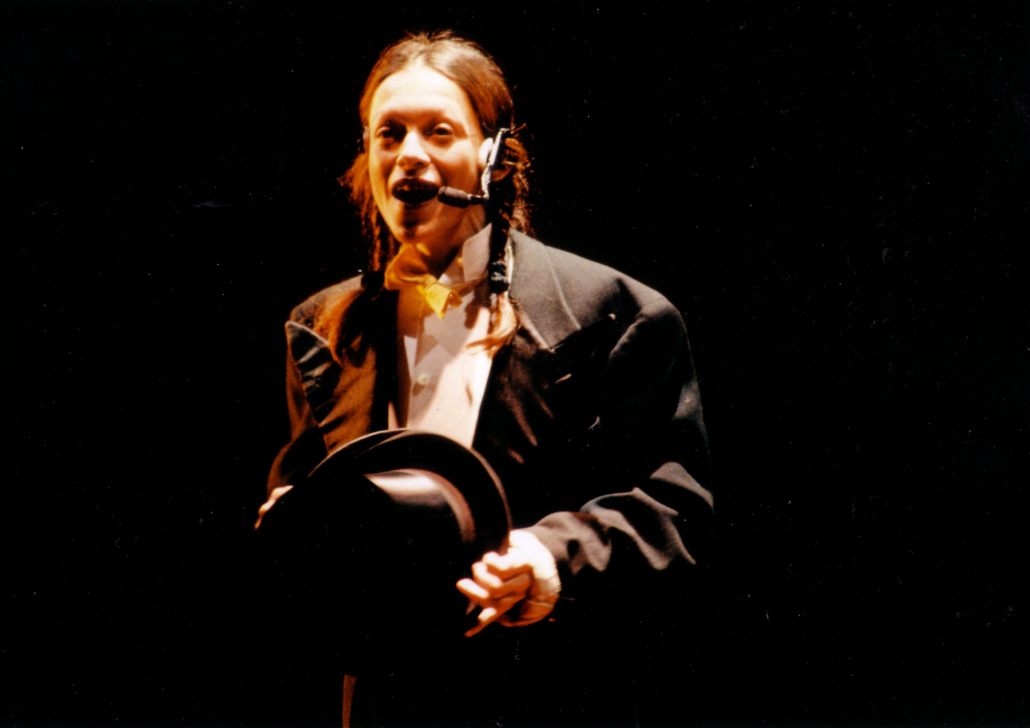
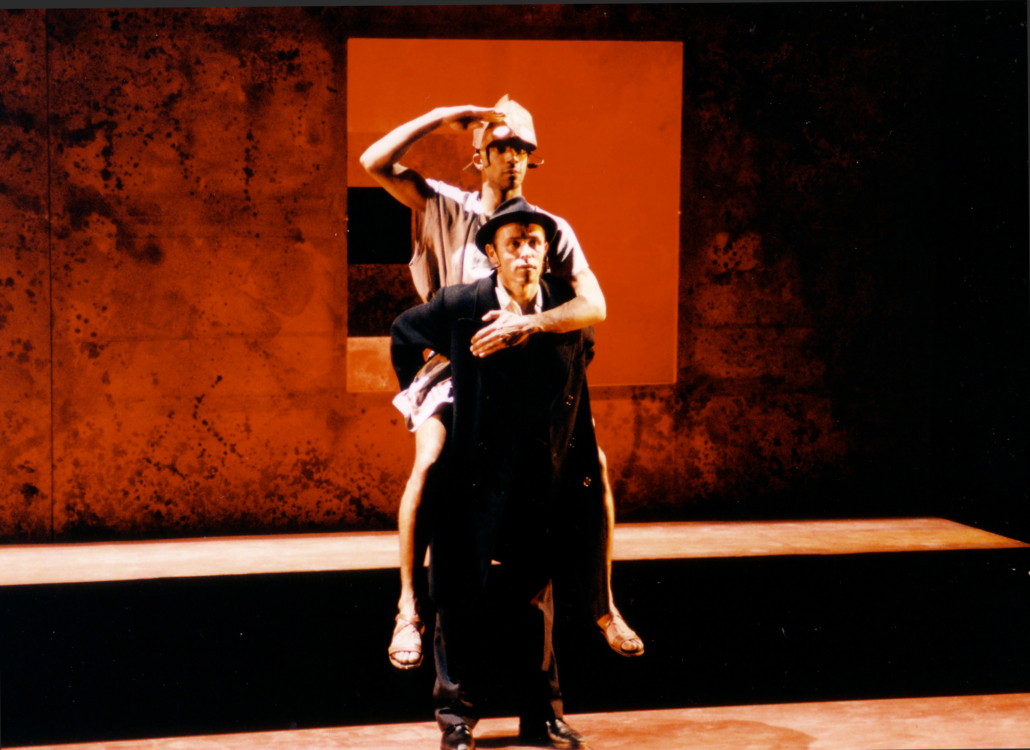
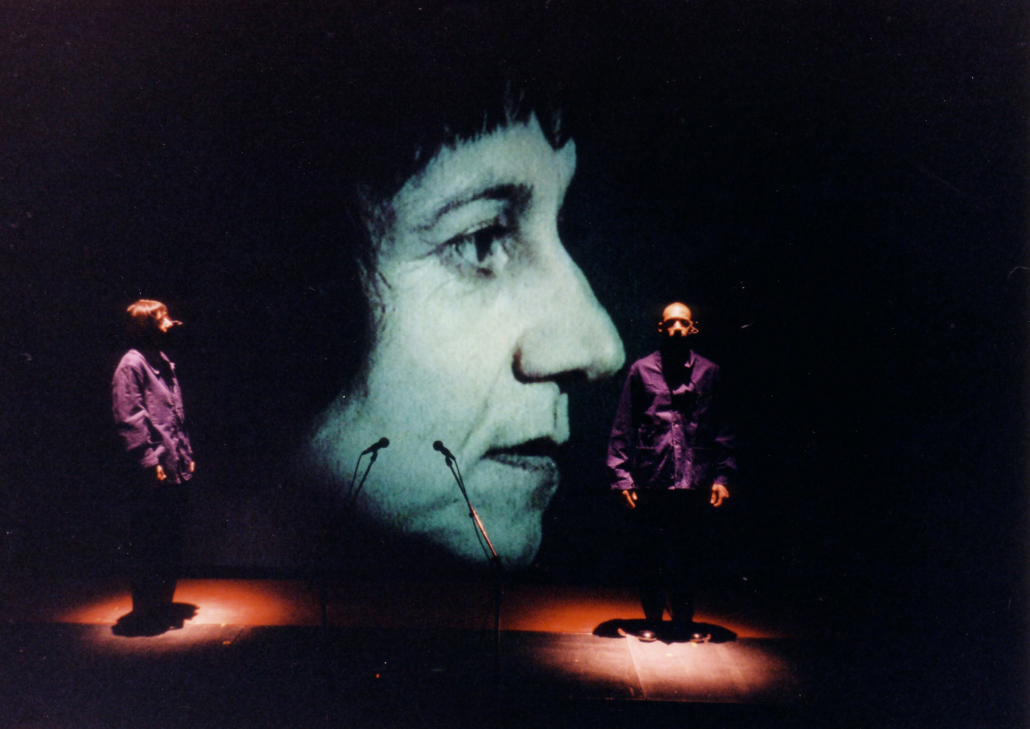
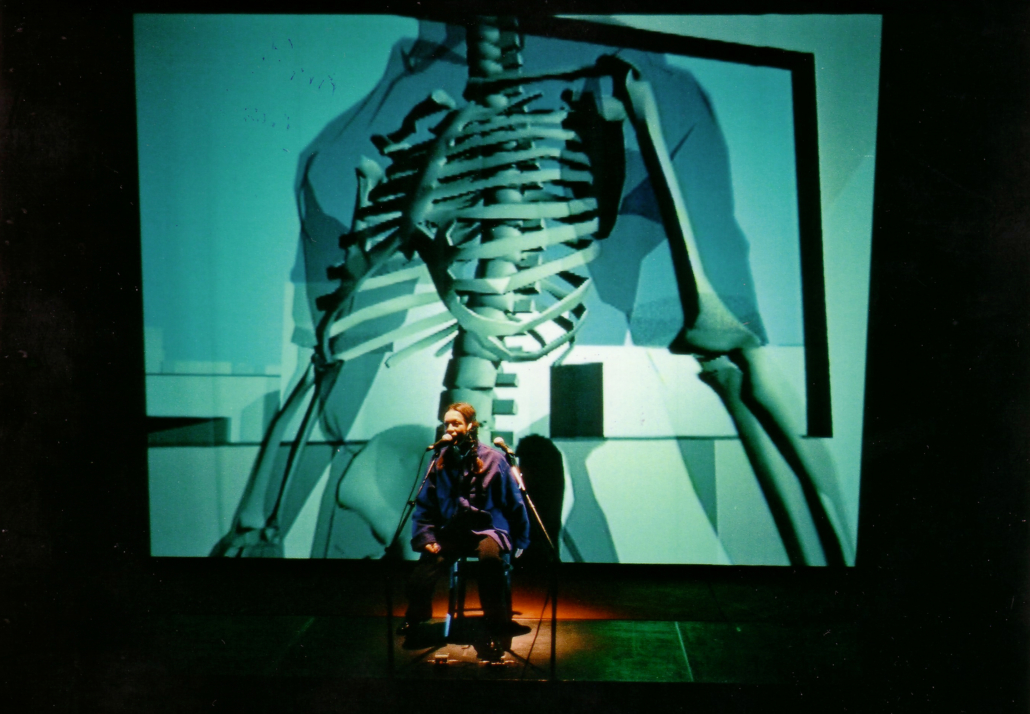
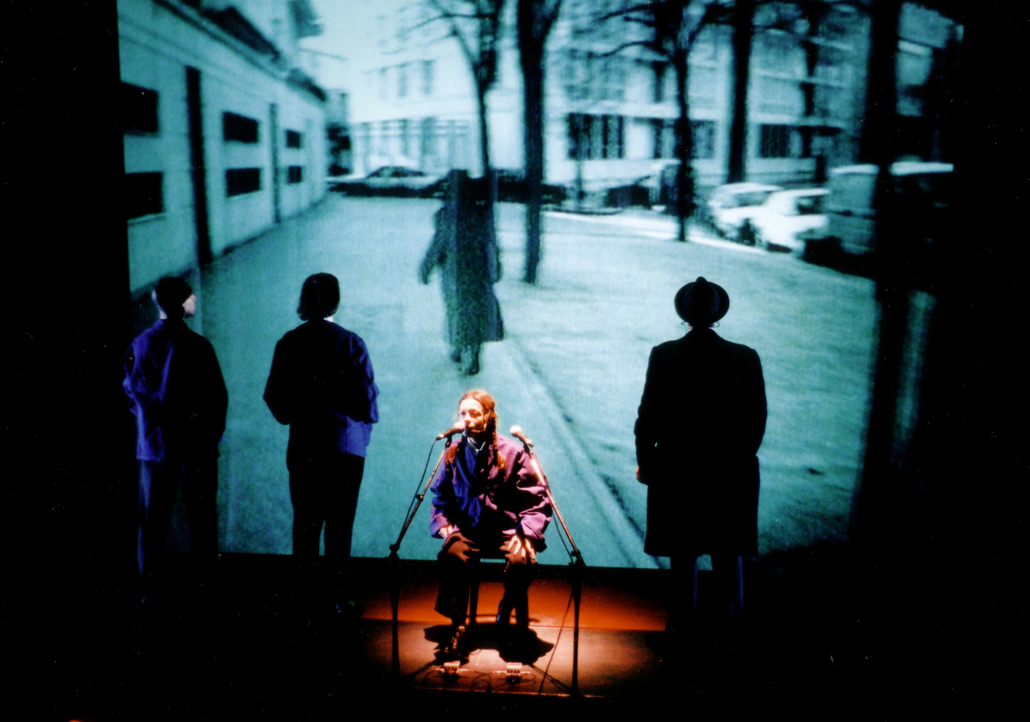
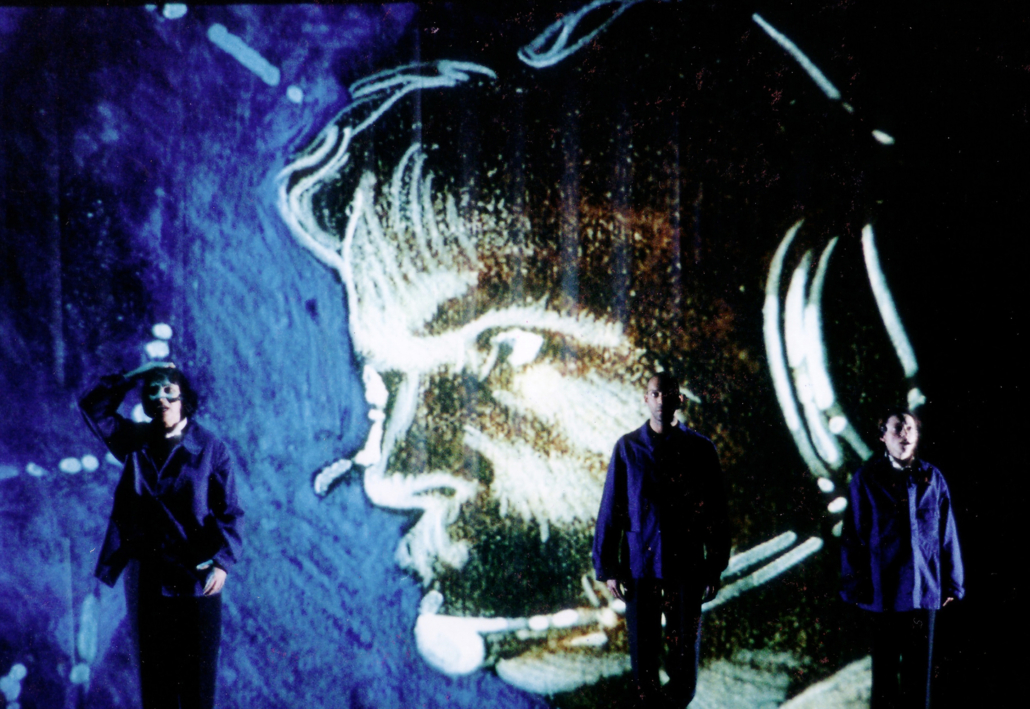
Photos Guy Vivien
Song of Sight (Ribac/Pasquier)
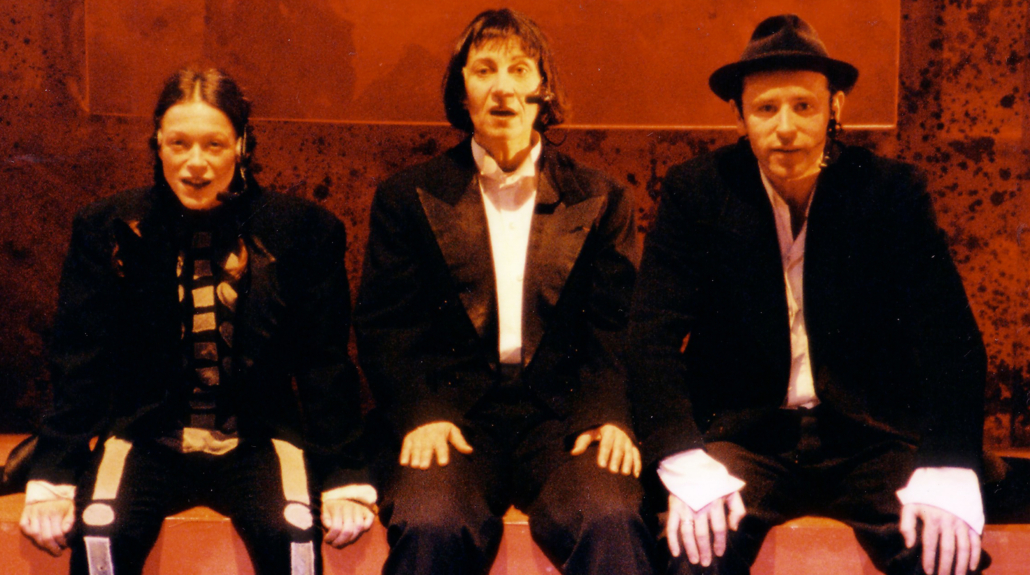
Vocals: Eva Schwabe, Ken Norris
Les argonautes (Ribac/Grünberg)
Vocals: Eva Schwabe, Marie Faye, Jean-Jacques Allaire, François Ribac
Listen to the album Le regard de Lyncée (MUSEA 2000)
Le regard de Lyncée
Premiered in April 1999 at the Forum Culturel du Blanc-Mesnil
An opera for three singers, a narrator, a jazz septet, and a string quartet
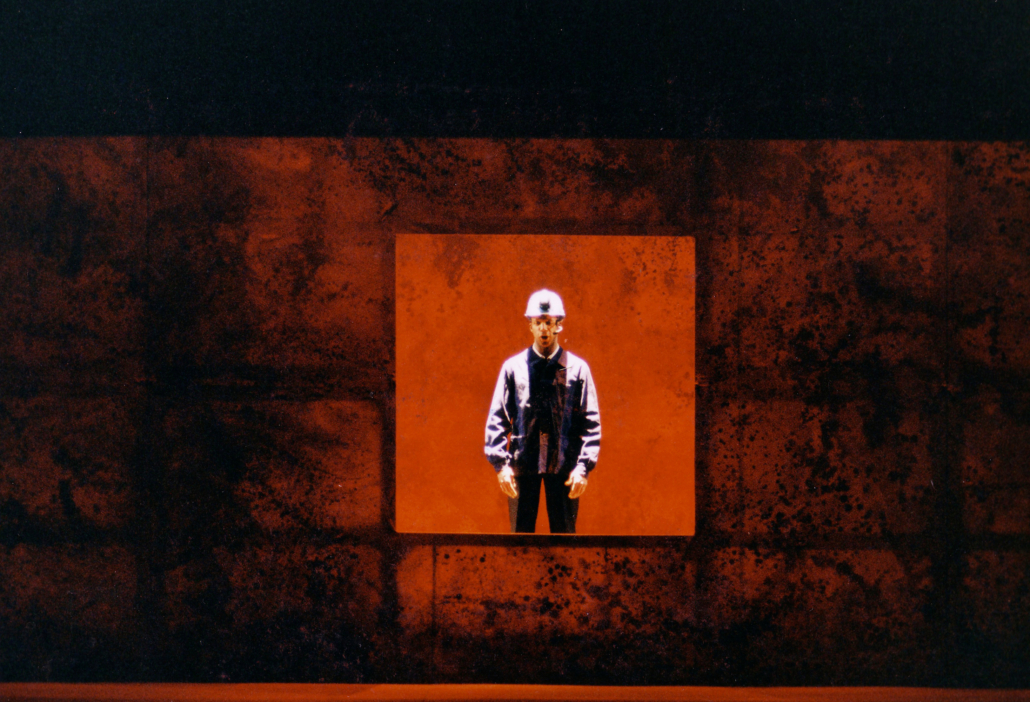
The Greek hero Lynceus appears in certain ancient texts. The twin brother of Idas, son of Aphareus, and a descendant of Perseus, he is the one who guides the Argonauts’ ship on its quest for the Golden Fleece. Another mythological episode recounts how, following a violent dispute with his cousins Castor and Pollux, he discovers them hiding inside a tree trunk. Because his gaze can pierce through solid matter and darkness, mythographers portray him as the ancestor of miners.
In his Faust Part II, Goethe depicts him as a watchman—born to look, and sworn to keep watch. Lynceus thus anticipates X-rays and spy satellites by millennia; he embodies, in mythological form, the dream of visual omniscience.
Our opera chronicles the transformations and transmutations of this hero:
1st period: The hero of Greek mythology and his expeditions.
2nd period: The invention of X-rays by Wilhelm Conrad Röntgen in 1895 (the year the Lumière brothers invented cinema), the exhibition of this technique at fairs and the dramas that it engenders.
3rd era: The digital eye, the civilization of ubiquitous screens (real-time observation satellites, computer-assisted microsurgery, ocular prostheses, virtual images, flow of images and information, the advent of cyberspace, etc.).
Presse
Le Monde
April 23, 1999
The story of the “cheerful yet serious” image set to music by François Ribac
Le Regard de Lyncée, music by François Ribac, directed by Patrice Bigel; texts by Marie-Claire Pasquier, Serge Grünberg, Hervé Le Tellier and Goethe. Premiered on 7 April 1999 at the Forum Culturel du Blanc-Mesnil. Performances: CNAT Le Manège in Reims, 28 and 29 April (to be confirmed), Espace Louis Lumière in Épinay sur Seine on 7 May, Moulin du Roc in Niort on 11 May, Centre des Bords de Marne on 18 May.
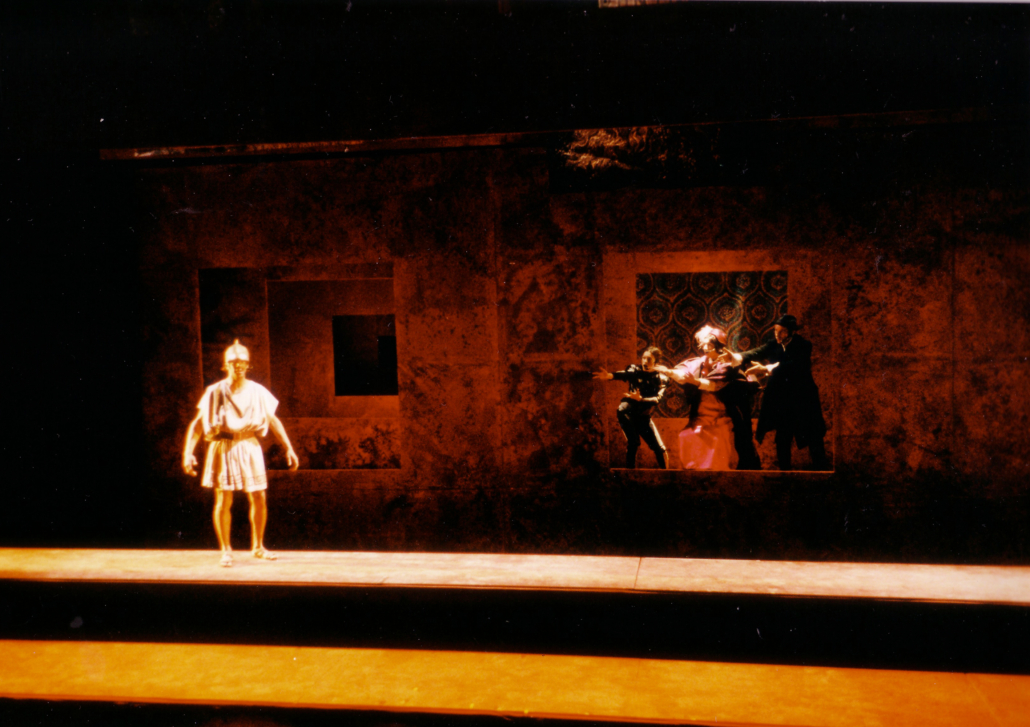
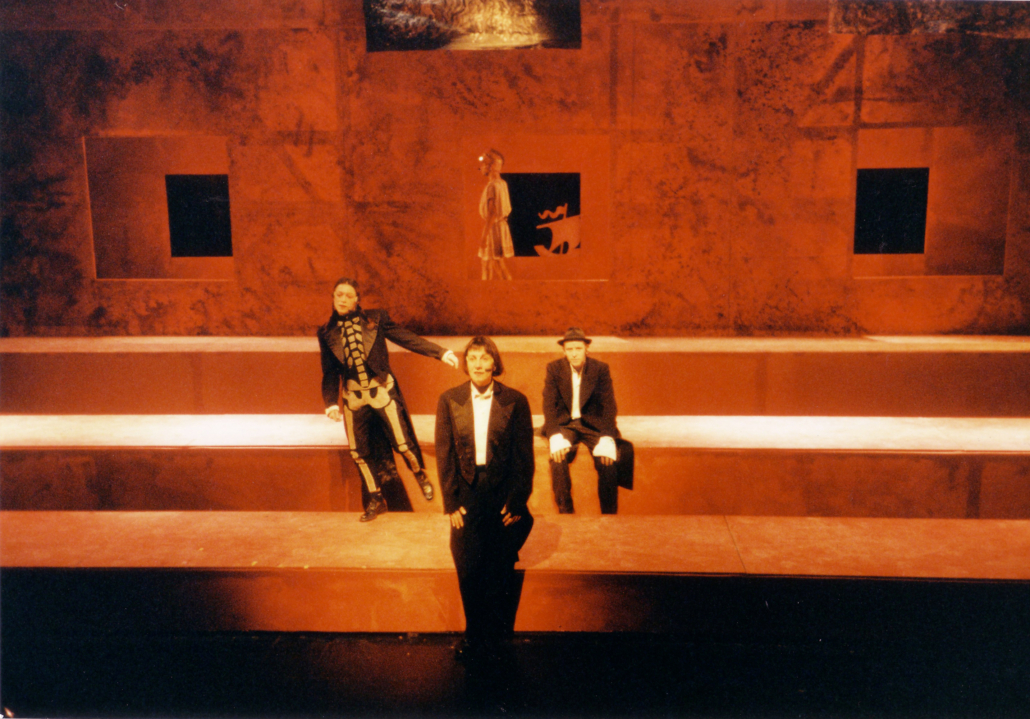
Large, brownish-orange painted canvases pierced with square cutouts move back and forth at varying speeds—up and down or across the stage. Three actor-singers appear intermittently within these squares. One imagines them in a lift that plunges into the darkness of a mine, they seem to walk towards infinity. Thanks to an optical effect, the spectator becomes part of this movement.
Later on, there will also be a bare stage, projections and other effects. It’s simple, effective, and holds a touch of magic. Le Regard de Lyncée, a musical show -Patrice Bigel is the director, François Ribac the composer- tells, in songs, instrumental passages and three “acts”, the history of the image since the 19th century, from the discovery of X-rays by the German physicist Röntgen to the planetary network of satellites and the Internet. Lynceus, a character from mythology, serves as a unifying thread.
François Ribac created the dramatic concept and the music. He has a background in free jazz while also having listened to 1970s bands like Soft Machine, King Crimson, Henry Cow, and German rock acts such as Can or Faust. His music comes from some of the rhythmic figures of Igor Stravinsky -inspired by Frank Zappa, who sometimes comes to mind- some of the limpid melodies of pop, some of the dreamy melancholy of Robert Wyatt and a form of neo-classical with a touch of Michael Westbrook Cabaret. All these influences allow the songs to exist. Vocalists Marie Grenon, Eva Schwabe and Ken Norris face a challenging task with the lyrics (those of Hervé Le Tellier are the most successful), sometimes narrative, at other times whimsical in a Queneau way. They must shift between samba and brass band styles, and from repetitive electronic music to jazz tunes; each genre demands its own specific breath and impulse. On opening night, perhaps due to some vocal strain, a few words were swallowed, and the balance with the backing track still needed fine-tuning.
Yet, one could clearly see and hear the direction Regard was taking: a cheerful and serious work, modern and poetic, a bit like an Italian opera or a musical with its share of surprises to revive interest without falling into the spectacular.
Sylvain Siclier
La lettre du musicien
summer of 1999
“Le regard de Lyncée” by François Ribac
“I am granted a view like that of the lynx atop the highest tree, yet it is not merely for my own delight that I am stationed here, at the very summit: what a spectacle of dread and horror emerges, looming over the darkened world.”
It is from these lines of Faust that François Ribac (born in 1961) has conceived his latest chamber opera Le regard de Lyncée, lending new metamorphoses to the Greek hero revisited by Goethe;
Appearing variously as an X-ray, a 19th-century fairground attraction, and a spy satellite—set to a libretto that is somewhat kitsch (is it tongue-in-cheek or played straight?)—Lyncée traverses three eras, each musically illustrated by a distinct narrative style: modal language and recitatives for the mythological tales, popular music and frenetic rhythms for the fairground scenes, and expansive lyrical passages for the Space Age.
The three singers, Marie Grenon, Eva Schwabe and Ken Norris, are remarkable both for the quality of their interpretation and their ability to navigate the diverse melodic genres demanded by the score; operatic singing, vocalises, and cabaret or rock styles, engage in vocal canons with themselves via a looping system—reminiscent of Steve Reich’s Counterpoint series—and come together in beautiful ensemble passages.
The “orchestra,” composed of musicians from the Musiques en Scène company, is made up of nine instruments—including acoustic and amplified acoustic instruments—as well as synthesizers. The set design itself evolves from the theatre machinery to the device of the magnificent final act;
where alternating – in phase with the music – synthetic images, filmed scenes or animated drawings, the screen comments on the action, sets a scene, doubles the characters or creates the movement that surrounds the performers.
The range of styles deployed by François Ribac—a former rock and jazz bassist who came to “serious” music relatively late—reflects the multiple influences of his winding career path. “It is not so much a matter of borrowing as of leaving a mark,” he succinctly puts it. It was at the end of a two-month tour in France that we were able to hear Lyncée at the Centre des Bords de Marne in Le Perreux (18 May).
Grégoire Hetzel
Le Monde de la Musique
april 1999
Le regard de Lyncée
Composer in residence at Blanc-Mesnil for three years, François Ribac has created a new show, Le Regard de Lyncée, directed by Patrice Bigel.
At the confluence of rock, improvised music and contemporary creation, François Ribac has been composing for stage and screen since 1986. Co-winner of the Fondation Beaumarchais with his opera Le Regard de Lyncée, last February he won another composition prize, awarded by Pro Lyrica and the SACD (Société des auteurs et Compositeurs Dramatiques) for the musical Qui est Fou? featuring a libretto by Hervé Le Tellier. Whether his scores were intended for Jean-Louis Bertucelli’s films, the silent film La Rue (Kinopéra, 1997) or for his theatre company – the chamber operas Marguerite Ida and Helena Annabel based on Gertrude Stein (1992) and Un Demi Siècle/ Ein Halbes Jahrhundert (1995) – his music is in a popular vein that is sometimes reinvented, Yet, this approach does not preclude an exploration of timbre and a unique sense of prosody, echoing the spirit of American composers Robert Ashley and Steve Reich.
With three singers (Marie Grenon, soprano, Eva Schwabe, alto, Ken Norris, baritone), a narrator (Jacques Allaire) and a small orchestra, Le Regard de Lyncée is intended to be a show “about the present world and the ideology of technology; the computer and the mobile phone, multimedia and ‘cyberpositivism’. Obviously, like most musicians, I too handle this technology with the same kind of general excitement. Yet I did not want to create a parody—a sort of musical comedy about the Internet and Bill Gates… although…” In the figure of the Argonaut Lynceus—a peripheral hero of Greek mythology—I found the embodiment of the visionary: the one who guides the way through the mist, spots gold through solid rock, and, in Goethe’s Faust, Part Two, glimpses armies in the distance. I am less interested in the hero of antiquity than in his ‘modern’ double.
Working from a dramaturgical framework we had devised beforehand, we asked writers (Marie-Claire Pasquier, Hervé Le Tellier, Serge Grünberg) to write scenes in their own preferred styles. The figure of Lynceus is presented in three periods: from the Homeric epic to the 19th-century novels of Jules Verne—a time when fairground booths displayed Röntgen’s newly discovered X-rays to curious onlookers—and finally to the present day and the age of increasingly sophisticated machinery: observation and weather satellites, surgical cameras, ocular prostheses, and virtual imagery.
Vocally, François Ribac has sought to use different modes for his three eras. Thus, for the Greeks, the song favours the curve of the recitative and the rhythm of the dance, while in the modern era, several voices intertwine. The collaboration with stage director Patrice Bigel (based at the Usine Hollander in Choisy-le-Roi) for Regard de Lyncée is no coincidence: he is one of the rare theater practitioners who pays meticulous attention to the soundtracks of his productions. This is his second opera production, since in 1993 he directed Massenet’s Cid in Rouen.
Franck Mallet
Premiere at the Forum Culturel du Blanc-Mesnil on 7 and 8 April. Subsequent performances on 28 (8.45pm) and 29 (2.30pm) April at the Manège in Reims, on 7 May (8.30pm) at the Espace Louis Lumière in Épinay sur Seine, on 11 May (8.30pm) at the Moulin du Roc in Niort and on 18 May (8.30pm) at the Centre des Bords de Marne in Le Perreux.
La Terrasse
april 1999
The emulation scene
Coming from rock, having passed through jazz, influenced by the new American music, François Ribac confirms his fascination for the stage by signing his fourth opera Le Regard de Lyncée. A fable in which the Greek hero, resurrected by Goethe in Faust, casts his sharp eye over different eras, from ancient Greece to the present day. First performed on 7 and 8 April in Blanc-Mesnil, directed by Patrice Bigel, with the complicity of Eva Schwabe, companion and main performer for this young iconoclastic 37-year-old composer.
– You started your musical career as a rock bass player, today you compose operas…
François Ribac :
I believe there is a close relationship between rock, jazz and vocal music. One of the characteristics of rock at its best is that it is always sung, that there is text, meaning. There are also some truly great poets in the history of rock. For someone like me who has a rock culture and a jazz culture, the fact of doing operatic productions is not a coincidence. The voice has been at the centre of my thinking and my work since the very beginning.
– Should we really call Le Regard de Lyncée an opera? After all, the musical world you inhabit doesn’t necessarily align with the traditional realm of opera…
François Ribac :
It is an opera—even if, for the general public, the term is often synonymous with the forms prevalent in the 18th and 19th centuries. When we speak of opera, we are talking about two things. First, stories that are sung, I think that’s what’s essential. And second, a performance that is inherently hybrid, designed to combine different art forms. Of course, I use the term “opera” in the sense that Philip Glass and Bob Wilson did for Einstein on the Beach, or like Meredith Monk or Robert Ashley have. When they talk about opera, it’s really about musical narrative. From the point of view of musical aesthetics, I work with singers who use microphones, with timbres that are natural voices. On the other hand, as far as the theatrical machinery is concerned, for the first part of this show, we work in a form that is really very close to that used in the 19th century.
-You are attached to an essentially Anglo-Saxon musical movement. Don’t you feel alone in France in this approach?
François Ribac :
You’re asking an artist if he feels alone… (laughs). I think that there is a whole current of musicians today – it’s true that they are Anglo-Saxons – whose main interest is the theatre. My aim isn’t to position myself in opposition to, or in isolation from, the operatic trend—and the use of operatic tradition—that is indeed found in contemporary music. It’s not a question of being a breaker. I place myself in a different tradition, on that, musically speaking, is closer to jazz or certain strains of rock and more generally to what one might call Anglo-Saxon art music, but which also centers on dramaturgy, stagecraft, and the stage in general. I share a great deal with theater people, which isn’t always the case for musicians…
-Few musicians renounce the vocal technique of “grand opera” as you do…
François Ribac :
The technique of opera is largely linked to the bel canto era, to the shape of the theatres, to the fact that the voice had to be heard above the orchestra and that this orchestra, at the time of Puccini and Richard Strauss, was very massive. Now that technology allows us to amplify the voice, we can choose to keep these vocal techniques for aesthetic reasons but the physical necessity for them has vanished. It’s true that I’ve always been surprised to see, in certain musical currents, people who profess modernity on questions of instrumentation, musical writing and even dramaturgy, and who, on the question of vocal technique, remain in a petrified dogma.
Interview by Jean Lukas
Latest news
 16th march 2026 – Some news16 March 2026 - 10h00
 François Ribac 16-03-1961 – 06-11-202415 November 2024 - 11h38

