

Photos Guy Vivien
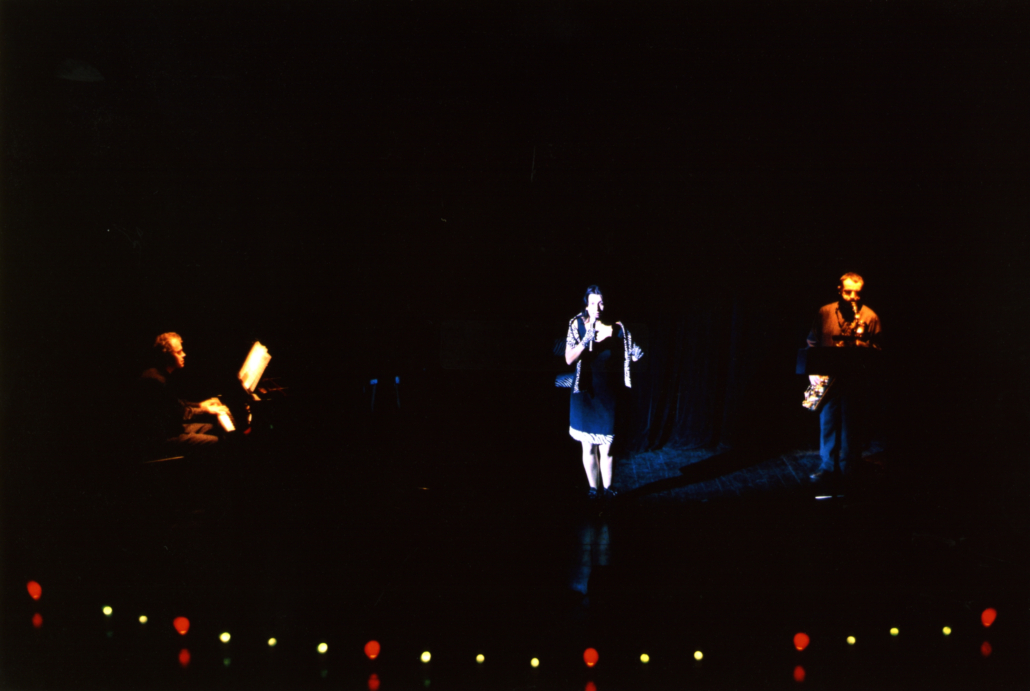
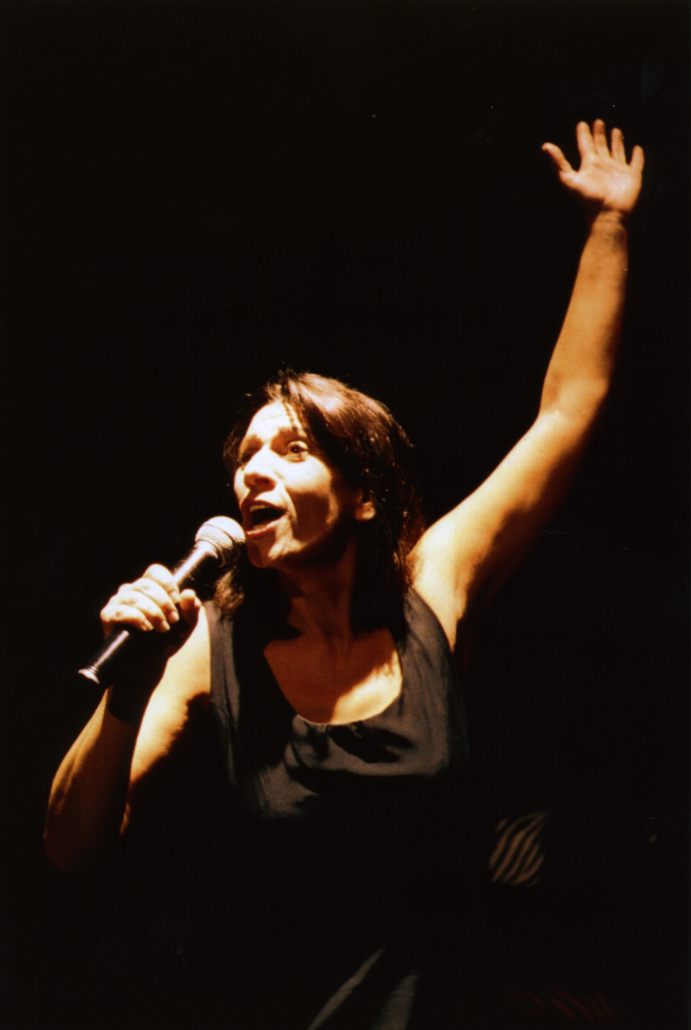
Cabaret Berlin – Paris
Songs by Kurt Weill, Hanns Eisler and François Ribac in french, german and english.
First performed in 1994 in the foyer of the Théâtre National de Chaillot (Paris)
Most of Eva Schwabe’s cabaret songs were written in the 1920s. At that time, Berlin was a hotbed of intense creativity across all artistic fields: following the trauma of the First World War and relentless political upheaval, the young artistic generation was seeking new forms – concise and ironic, innovative and accessible. These artists wanted to break away from the formalities of academic and ‘bourgeois’ theatre.
The poet Bertolt Brecht and the composer Kurt Weill join forces and revolutionise opera with the Opéra de Quatre Sous. They invent what the philosopher Ernst Bloch calls the art of the Schlager: Brecht writes about the metropolis, its new myths and the misery that reign there. His characters, far from romances and kitsch, are real figures: barmaids, sailors, liquor dealers, Salvation Army soldiers, prostitutes etc…
Kurt Weill’s scores blend classical music with popular rhythms, brass bands and the classical string orchestra. Weill is an exceptional melodist. Often we do not know enough about the songs he composes during his exile in Paris with the writers Maurice Magre and Jacques Deval.
Another of Brecht’s collaborators, Hanns Eisler, also contributes to the emergence of a new genre: political cabaret. Following the rise of Nazism in Germany, he emigrates to the USA, settles in Hollywood and writes for the cinema. Here, he composes a cycle entitled Hollywood Elegies, which depicts the fake world of the studios with bitterness and ferocity.
This Cabaret also features songs written by François Ribac for Eva Schwabe and her musicians.
Press
Les INROCKUPTIBLES
week of 20 – 26 May 1998. n°152
HANNS EISLER
Songs and Lieder
Eva Schwabe (vocals)
Christopher Bjurstrôm (piano) in concert
In Germany – and at the Goethe Institute in France – the centenary of the birth of Bertolt Brecht and the composer Hanns Eisler, both born in 1898, is being celebrated this year. When we think of Brecht as a lyricist, we think first and foremost of his association with Kurt Weil, who gave us The Rise and Fall of the City of Mahagonny, The Threepenny Opera and The Seven Deadly Sins. But we must not forget Eisler, with whom the playwright collaborated during the Weimar Republic, the musician and the writer were both part of the artistic and political avant-garde that fought against the rise of Nazism. Alongside Webern and Berg, Eisler was Arnold Schönberg’s third Viennese pupil, and one of the few artists to reflect on the social function of music.
A versatile composer, he wrote numerous melodies, ‘workers’ cantatas’, as well as revolutionary songs and scores for the stage and cinema. Whilst his chamber music, and indeed his symphonic works, bear witness both to the influence of his mentor Schönberg and to a style that draws on folk traditions —such as the Septet No. 2, composed in collaboration with Chaplin for the film The Circus—his melodies and ballads for choir (Massenlieder), on the other hand, are modelled on the declamatory rhythm of protest texts. This crisp, lively style, with its harmony simplified to the extreme, immediately appealed to many performers who, as with Weill’s songs, revelled in this cheerful and expressive rhythm, somewhere between cabaret and jazz.
Fleeing Germany in 1933, Eisler turned to the cinema and composed more than 25 scores for, amongst others, Fritz Lang (Even Executioners Die), Jacques Feyder (The Big Game), Jean Renoir (The Woman on the Beach) and Alain Resnais (Night and Fog).
His insightful reflections were published under the titles Musique de Cinéma (with Adorno, L’arche, 1972) and Musique et Société, and collected to mark his centenary by Albrecht Betz (Maison des Sciences de l’Homme, 1998). A leading interpreter of Weill and Eisler, Eva Schwabe is one of those very rare singers who possess that cabaret style, which is ideal for this repertoire.
Franck Mallet
25 May (9.00 pm) at the Goethe-Institut, 17 avenue d’Iena, Paris XVI.
Latest news
 16th march 2026 – Some news16 March 2026 - 10h00
 François Ribac 16-03-1961 – 06-11-202415 November 2024 - 11h38
