Le regard de Lyncée
François Ribac

François Ribac
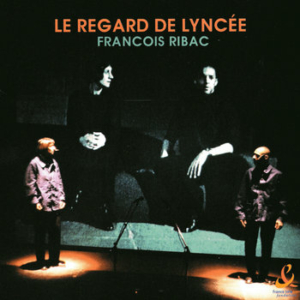
Gazul/Musea
January 27, 2001 – Record Selection
Generally, music created for a performance (dance, theater, etc.) or a film loses some of its impact when transferred to a recording. Le Regard de Lyncée—the soundtrack to the eponymous show premiered at the Forum Culturel du Blanc-Mesnil (reviewed in Le Monde on April 23, 1999)—avoids this pitfall.
Without losing sight of the history of imagery from the 19th century to the Internet age—a history rich in stage effects involving light, apparitions, and metamorphoses—the musical work takes on a life of its own.
Bassist, guitarist, keyboardist, and composer François Ribac draws from various genres (jazz, cabaret, pop) without getting lost in them; he borrows the narrative format of the song—using texts by Goethe, Marie-Claire Pasquier, Hervé
Le Tellier, and Serge Grünberg—while avoiding the over-emphasis of dramatic declamation. Instrumental passages enter at just the right moment, and the mix of languages (French, German, English) keeps the listener engaged. Expertly performed by a small ensemble of wind instruments (flutes, clarinets, saxophones, trumpet) and percussion, Le Regard de Lyncée also serves as a sensitive, well-conceived demonstration of the potential link between electronic and acoustic sounds.
With its dedication to Robert Wyatt, Le Regard de Lyncée stands as a recording that transcends trends, defined by a subtle interplay between cheerfulness and melancholy.
Sylvain Siclier
1 CD Gazul Records GA 8641.AR.
Distributed by Musea
2000
Composer and musician François Ribac is no newcomer to the “creative” music scene. In addition to composing scores for feature films, shorts, medium-length films, and documentaries—including works for the TV channel Arte—he founded the Compagnie Musiques en Scène in 1995. His compositions include Kinopera (an opera for the 1923 film La Rue); Le Regard de Lyncée (1999), which launched his three-year residency at the Forum Culturel du Blanc-Mesnil; and the staging and new orchestration of the opera Marguerite Ida et Helena Annabel (2000).
The opera Le Regard de Lyncée—François Ribac’s third CD for Musea (released this time on the Gazul label)—is dedicated to Robert Wyatt, one of his key inspirations. While the work might initially draw comparisons to the music of Michael Mantler or even the Soup Songs project, one quickly notices a more electric instrumentation. The standard lineup of flutes, clarinets, saxophones, flugelhorns, trumpets, drums, and piano is augmented by extensive percussion (marimba, crotales, gongs, zarb, etc.), electric guitar and bass, as well as programming, samples, and vocoders that lend the piece a distinctive sonic character. Blending musical theater and drama, the text is delivered through both spoken word and song—sometimes featuring slightly altered vocals—while certain vocal passages are reminiscent of the catchy tunes of Toupidek Limonade.
It is also worth noting that in 2000, François Ribac won the SACD composition competition and the “Musique nouvelle en liberté” prize for his musical Qui est fou ? …scheduled for 2001. Let’s hope Gazul follows suit…
Sylvie Hamon
September 2000 – Record reviews
Like other young French composers born around the turn of the 1960s—such as François Narboni, Vincent Bouchot, and Kasper Toeplitz—François Ribac writes in a style that integrates a wide variety of currents. His works thus incorporate elements of contemporary music (serial, spectral, or minimalist writing) alongside rock and jazz. His music is designed for the stage, much like his two previous works, La Nef du Roi Moselle (Muséa, 1992) and Marguerite Ida et Helena Annabel (No Man’s Land, 1993; Le Monde de la Musique No. 172). With their rhythmic shifts in atmosphere and orchestration, the music of Soft Machine and Frank Zappa appears to serve as a distant model for Le Regard de Lyncée. In fact, François Ribac’s approach mirrors that of Mike Westbrook in its aim to combine text, music, video, and computer-generated imagery within a single performance. Here, through the lesser-known figure of the Greek hero Lynceus (a watchman endowed with omniscience), the composer evokes new imaging technologies and virtual reality; the narrative transports us from antiquity to the 20th century, set to texts by Marie-Claire Pasquier, Serge Grünberg, and Hervé Le Tellier. Premiered in April 1999 and performed notably in Seine-Saint-Denis, Le Regard de Lyncée perpetuates—while simultaneously reinventing—the musical theater genre. The voices of Eva Schwabe, Marie Grenon, and Ken Norris possess the ideal timbre and flexibility to capture the vitality of this music.
Franck Mallet
Marie Grenon, Eva Schwabe, Ken Norris (vocals), Jacques Allaire (narrator), Sylvaine Candille (flutes), Francis Touchard (clarinets), Frédéric Saumagne (saxophones), Yann Martin (flugelhorn, trumpet), Nathalie Rives (percussion), François Bellin (drums), François Ribac (keyboards, guitars).
____________
1 CD Gazul GA 8641 AR (distributed by Muséa)
Liner notes and booklet in French
Recorded in 1999 – Duration: 1h 3′
DDD


 Another Way (Gazul 2002)