Tribute to
François Ribac

In french
Joëlle Le Marec : Hommage à François Ribac in Revue d‘ANTHROPOLOGIES des CONNAISSANCES (RAC)
Forthcoming
- In french
- Loïc Riom : Thinking Popular Music through Science and Technology (and Back): A Tribute to François Ribac in VOLUME !
- In english
- Simon Frith, Paul Harkins et Nick Prior : A tribute to François Ribac in Popular Music.
Friends and colleagues have come together twice to pay tribute to François. Here are some excerpts from the speeches that were given. The two meetings took place in November 2024 and then in November 2025.
We grew up and grew old together, even when we lived in different places…
A shared history – of political passions – the ‘T3’ of the Ligue Communiste Révolutionnaire; the expectations raised by democratic opposition in the countries of Eastern Europe; the disillusions too; and much later issues of Mouvements – but also of fascination for surrealism, of literary and pictorial discoveries, and of course music. François is responsible for many of our great classics, starting with Marthaler’s hilarious stage productions…
Because sharing was also sharing a sense of humour – François’ insolent, devastating sense of humour, nourished by his Jewishness.…
François was an attentive, discreet friend who knew us well, who sometimes understood things we didn’t know ourselves, who respected our choices and our tastes…
Irène Jami

…I met François for the first time 38 years ago, in 1986. That year, I was commissioned to direct a show in Offenbach, a small town near Frankfurt am Main, adapted from Sur la route by Jack Kerouac….In Offenbach, I asked the person commissioning the show to bring together a small jazz ensemble in addition to the actors and actresses, and François immediately started rehearsing with them….
I don’t have a lot on my plate, but I try to put on a brave face in front of the cast. I take my cue from François, who is so solid, precise and joyful with his musicians. That’s the lesson I learn from him: no sad passion, you have to do what you have to do honestly, aware of the difficulties without ever giving them the upper hand….
For seven consecutive years, we worked together. François agreed to become the composer of the Harlekin Art festival that I founded in Bayreuth and Turin, before moving it to Metz.
Eva, whom I met in Berlin, took part with a group of young actors. François composed some fabulous songs for her show about the Dolomites and the bananas that East Germans would come to West Berlin to buy on the night the wall came down. These two found each other for good and I became friends with them both, so proud and touched by their meeting at my festival.…
In 2019, renewing our old collaboration, I’m coming to Dijon to take part in the gigantic Grand Orchestre de la Transition project. I’m in charge of a group of university students whom I’m introducing to the mask game. They want to represent non-human entities, melting glaciers, mountain torrents, disastrous floods, animals fleeing global warming by going underground. They will use larval masks from the neighbouring Basel carnival to a precise score composed by François. They are the ones featured on the cover of François’ latest book, Arts de la Scène et Musique dans l’Anthropocène…
Didier Doumergue

…And then everyone went their own way, without losing each other, but at a distance, if only because of the moves. Fortunately, friendship doesn’t just take time; it also creates time, of a different quality, for example with François and Eva’s constant invitations to stay at St Valérien, another place where we could share life, with the extraordinary garden that Eva tended there, with the sea less than an hour away, and with the care and humour that François showed our daughters.
St Valérien was also the base for another encounter between us, this time around music and science. François, the perfect self-taught man, had decided to do a thesis. And he started reading up on the social sciences of culture, as he had been doing since the 80s, in a bulimic way and in unexpected directions, taking on the question of know-how, learning by doing, and their role in the musical experience. And like Rancière’s Jacotot, capable of learning and thinking for himself by arranging relationships with others in his own original way, François has mobilised his friends, old and new. So once again, St Valérien was also about evenings – not quite nights, as we grow older – talking about life, of course, but also about social studies, science and technology. And it all culminates in this fascinating book : l‘Avaleur de Rock, with its practices, its groups, its studios, its media, its concerts, its labels…
Unexpectedly, this bold entry into the world of the sociology of art also allowed us to involve François in another political endeavor—the one championed by the journal *Mouvements*—and, in particular, its “Techno” issue, a story of bodies and machines whose preparation was marked by both joys and worries, because, for François, was also about that: the ability to argue AND to make up.
Partner, comrade, sidekick, colleague—the lines blur: a friend for life…
So to leave you with just one quote, from « Racine carrée du verbe être » : : « If it is true that we are full of ghosts and that these ghosts protect us as we protect those for whom we are ghosts, then I think of you whom I would have loved and I tell you that you are my most beautiful ghosts. »
Ciao boy. Thank you for all your time.
Jean-Paul Gaudillière
Francois was my uncle and much more. He meant a lot to me. His courage and integrity both guided and comforted me. …I didn’t always share his intransigence, but I always respected his indignation, his anger, his uprightness, his ability to stand up for himself…
Thank you for having embodied for me the possibility of a beautiful and uncompromising life, of becoming an adult while keeping intact the purity and vulnerability of a little boy of 63, never betraying himself, never denying, knowing how to see and find love and beauty where they were…
Francois, you offered me your love and your understanding, and you helped me to move forward.
Thank you Francois for embellishing my life.
Julie Creven

….And then François looked at Flora and me and told us to come and see something. The thing was two guitars, one for Flora to accompany her on vocals, and the LesPaul for me.
Flora and François and I sat upstairs in the micro studio where his guitars are stacked up to the ceiling. Flora and I improvised, François listened, and then he said « the guitars have been adopted ».
He told me to come and record in the Morvan. I came with a friend, we got out the bass and the LesPaul, we played and we sang. We recorded something terrible, which François fixed as best he could. We recorded something horrible, but we learnt a lot of things. François listened to me play classical guitar, after all. He told me he was glad I hadn’t given up. The conservatoire had been rehabilitated a bit…..
….When I hear music I don’t know, I always think of François. It often happens that you hear music you don’t know. Music, in our house, is a family affair. A family with François and Eva.
I won’t miss La LesPaul. Her music will go a long way with me. I wish François was still here.
Nadja Gaudillière-Jami
Dear François,
I met you in 1993 when « Pour ramasser la rose », in which Frédéric sang, was being performed. I’d seen so much of that show that I knew every song and every scene. I was discovering a singular, original music that blended musical comedy, pop, classical and contemporary music. There was something luminous about it that fascinated me. A few months later, you asked me to audition and since then you’ve never stopped trusting me to bring your musical universe to the stage…
You have been extremely loyal and faithful to the musicians, singers and people you have chosen to share your shows. You were a trailblazer, a man at the cutting edge of progress, proposing challenges ahead of your time such as the use of loops and mixing desks on stage…
Marie Faye

…Perhaps among the thousand things we could mention here to get a feel for all that lives between us thanks to you, I’ll choose a few, among so many possible ones, not necessarily the most obvious…
….For example, the way you ask questions.
As we wrote quite a lot together and there were many conversations about each text, what struck me quickly was the fact that, in relation to what you were saying or trying out or proposing, when you asked the question of what we thought about it (« what do you think? »), it wasn’t rhetorical. They weren’t the same questions you ask to force a reaction, to check something out. These were questions to which you really listened for the answer. And the answer, which we are sometimes tempted to formulate quickly in order to move forward and do several things at once (maintain an agreement, maintain a discussion thread, etc.), the answer had to be up to the task, responsible in the full sense of the word. So I was often touched and admired by the mixture of scientific authority, very strongly held positions, theoretical and erudite power in the arguments, and intense real doubt, scrupulousness and genuine expectation of what I could think. What was said counted. There were phone calls, and I remember where I was during these calls, where I understood that you could decide something based on my answer, which is extremely rare. Then I’d call back because I was so consumed by this responsibility and by the feeling that I wasn’t taking my own answer seriously enough. And the conversation resumed…..
…..The mixture, a way of articulating everything, which is an ecology embodied in living life.
For example, there was immediately the priceless treasure of emotional ties that we don’t hide, but that we fully integrate into what we think and what occupies us, in particular what we seek to live politically. For example, the ideas you think about and live with Eva, which are immediately returned to you and enrich everything you do with others. What’s rare is to feel the extent to which things matter, and how much they are connected. …
Joëlle Le Marec
…I remember above all, and even more, the discussion that followed this academic presentation. On the steps of the Maison des Sciences de l’Homme in Dijon we talked about bass, jazz-rock, progressive rock… Tony Levin and Alain Caron, among many other things. It was an initial exchange that was to lead to a number of collaborations, and then a real friendship. A passionate, sincere and open exchange.
A few years later, after a number of collaborations, you came to us – with the enthusiasm and commitment that we all know you for – with the idea of a new project: the ASMA project, for « Performing Arts and Music in the Anthropocene »…
Indeed, you’ve been able to gather around you and federate this diversity of approaches, points of view and contributions into a coherent whole. This project is undoubtedly a success. The many actions, achievements and publications that have come out of it, as well as those yet to be published, bear witness to this. Your latest book is undeniable proof of the depth and topicality of your reflections on the subjects that have fuelled this project….
Thank you for everything.
Fabrice Pirolli

“Isn’t It a Pity“
In 2013, we performed Tout un monde de Strat(e)s in La Rochelle. The next performance was then in Mimizan. With new amateur musicians. The first part of Strates consisted of some songs from “All Things must pass” by George Harrison. Here is a first meeting with the people involved in the new performance. François comments on the song : Isn’t it a pity.
About ten years ago, when I first met him, he was Mr Ribac, one of my Master’s lecturers. Very early on in the first few lectures, I realised that this man did not share the same view of teaching as I had experienced up to that point. He is passionate, and that makes him a fascinating person.
…A few years later I was working in a theatre and François got in touch with me to come up with a project for his students. At the Déclic in Dijon he said to me: « What can we do? » The subtext of this question is: What can we offer that is not usual? I rediscovered the feeling that was familiar to me during his classes, the conviction that I was going to step out of my comfort zone again and that he was going to push me to go further in my professional practice. That’s what happened, with a pandemic that forced us to reinvent ourselves and bounce back once again. At the end he said to me « that was brilliant » and I was proud that my former teacher, this one in particular, would say those words….
And François was him. Unique. Singular. Joyful. Determined. Researcher. Enthusiast. Music lover.
Alexandra Chopard

© Marie Monteiro
…As I embarked on this research journey with you, I had in mind a fairly conventional method, inspired by Howard Becker’s study of the worlds of art and artistic labour, and by chains of cooperation. We immediately agreed on the primacy of fieldwork and the need to approach it in various ways. In reality, we adopted and adapted our methods ‘as we went along’ and, far from any methodological certainties or complacency, you drew on every available resource, giving digital technologies their rightful place. Taking screenshots of the overwhelming number of emails received by the ‘programmers’ – that was your idea; the study of networks, too, to understand the programmers within their external relationships and, at the same time, to grasp how the programming fits into the overall framework.
You, too, were the one who approached A. Mogoutov about the study using network maps of places and their reputations. Working alongside you, I even had the chance to try out the consensus conference as a research tool… But above all, I found something there that is not all that common in the academic world: a genuine sharing of the research subject and its questions, a collaborative process shaped by our discussions. I learnt a great deal from this – from the constant adjustments to the fieldwork, from that methodological restlessness…
I got to know François, and also Eva, whom he readily involved in our research: his insatiable curiosity, his intelligence and clarity of thought, his appetite for diverse ideas and methods (and here, as elsewhere, he is someone who draws you in, always on the move, always at work), his wholehearted, uncompromising nature, his contempt for hierarchies and institutional red tape. His feminism too – a feminism practised at every moment; I remember all our discussions on how to highlight the feminine in our writing; and finally, his humanism, his concern for the most vulnerable, and his anxiety about the ‘world falling apart’…
François is a man of passion and admiration. It is now my turn to express the admiration I have for his work and his art. Fortunately, I have told him so.
François used to play me rock bands that I’d loved so much, a long time ago… and others – all-female bands – that I often didn’t know. It’s this image, linked to Eva, that I want to hold on to.
Thank you, François…
Catherine Dutheil Pesssin

I’d like to testify to François’ generosity and enthusiasm. Universities move fast. Not that more advanced researchers aren’t interested, but they don’t always have the time. François took it in his stride and was happy to discuss things, to dare to take detours, above all to encourage – he was always careful to do this – and also to challenge: weren’t we just repeating a bit of a doxa?
When we had an appointment, I knew when we would start, but never when we would finish. And what I thought was going to be a short call could turn into two and a half hours of rambling discussions, ranging from the history of technology, to an acerbic critique of the concept of the network, to a long list of must-read books. There were also discussions about music, its mythologies, prog rock, the Beatles of course – there’s no escaping them – and more recently the pedal steel, an instrument which, despite all François’s teaching, seems to me, a poor musician, to be completely unintelligible!
All this was the experience of an encounter with François. On several occasions he was for me – and I know it’s true for others – a breath of fresh air. The sweetness, too, in the duo formed with Eva, which I felt from the first meeting in Porto, where she was also present, to a cup of tea in their flat in Dijon or their garden in the Morvan.
François, thank you for your friendship. I’ll keep your enthusiasm and generosity, goodbye boy,
Loïc Riom
…I must have first met François in 2004, in Avignon, right in the midst of the crisis surrounding the ‘intermittence’ issue. He’d told me about his book *L’avaleur de rock* and I must have told him I regretted that he hadn’t published it through us at IRMA (Information and Resource Centre for Contemporary Music).
When his book came out, I loved it. For its content, of course, but beyond that, for its contribution to our understanding of – and the rebellious nature of – our sector.
As Damien Tassin wrote at the time: ‘Ribac regards rock as a studio art’.
To remind us so brilliantly just how fundamental recording (the record) is to our culture struck a nerve in the face of the strangeness of cultural policies determined by the Ministry of Culture and Communication through its normative prisms: one Directorate for Creation, another for the industries.
No! Rock couldn’t be confined to the categorisation of ‘companies’ or bands active in the ‘performing arts’ as opposed to the commercial production of soundtracks for the audiovisual sector.
So I took great delight in getting François involved in all sorts of places where his views strayed from the beaten track: from the Planning Commission, where the Orfeo group was poring over ‘strategic policy’ regarding ‘artistic creation and labour’, to conferences organised by the Ministry of Culture and Communication in Toulouse, via the Lyon Centre for Music Teachers’ Training, the Grenoble Observatory of Cultural Policies, the Department of Studies, Statistics and Forecasting at the Ministry of Culture, and the first PopMind event organised by Fédélima (etc.)…
Most of the time, this provided him with an opportunity to produce a detailed contribution (whether a written piece or a presentation). In this way, he agreed to engage “in the debate”, to throw himself into it alongside the male (and female, if there were any) participants, not to represent a particular trend but, on the contrary, to shatter institutional conformism and sound the alarm…
Gilles Castagnac

…I wanted to pay tribute to François because I believe he is undoubtedly one of the intellectuals who has dealt most effectively with this issue – the interaction between culture, art and the Anthropocene.
I learnt a great deal from him, and I have truly wonderful memories of the intensity with which he approached this issue. From an intellectual point of view, of course, he knew everything there was to know about this issue, about its scope. That is rare in this field, in this line of thinking. And also because he had carried out research – very personal research at that, almost auto-ethnographic – into this very issue. And I learnt a great deal working alongside him. I also remember that we had a very interesting discussion about cultural attachments because, faced with the challenges of the Anthropocene, we are forced – or at least all our systems of evaluation are called into question.
And François would often tell me that the musical and artistic memories, and memories of concerts, that he’d had in his life were such profound experiences that they became more than mere attachments; that the word ‘ attachment’ was not sufficient to describe the relationship one can have with these cultural entities. And so I was deeply struck by this question because I realised that, ultimately, what he was addressing was one of the most pressing yet least documented issues—namely, the task of conducting an anthropology of culture and art, that is to say, a world that is, after all, quite pervasive in Western societies, and that this world—filled with entities and, indeed, with virtualities—posed a rather significant ecological problem, though one that was not necessarily the same as in other worlds or other sectors of activity. And this issue is a huge source of inspiration for me today, and I wanted to thank him because without him none of this would have happened – none of this reflection – and as I’m currently leading a research project on these very issues, François’s influence is with me every day, so thank you, François, for everything you’ve done, for everything you’ve given us, and big kisses wherever you are – we love you very much. Bye!
Diego Landivar
I met François Ribac as part of a small, informal research group that sought to explore the relationship between musical culture and technical culture, whilst avoiding a short-termist approach to research focused solely on digital innovation. His views on cultural policy were clear and courageous…..He was also one of the few with whom I was able to share the view that the Yellow Vests movement offered a lesson that would reshape environmental studies
He’s gone, and I’m going to miss him. I’d made a sort of new-old friend through my research at university; it was unexpected. Being with François was like suddenly finding a breath of fresh air that makes you think and realise you’d been holding your breath until then. You don’t think in the same way when you have a friend in the back of your mind who shares part of your intellectual journey, and who is prepared to take you more seriously than you take yourselves – because it amuses him and because he has a real appetite for it. Not because it’s a job to be done, but for the difference it might make. We had our disagreements, but above all we shared a kind of camaraderie, transcending our generational gap – a camaraderie mingled, for me, with a great deal of admiration for his rigour as a reader, his frankness and his generosity. He was stubborn and independent-minded to the point of sometimes being brutal, yet also warm and sensitive in his own way. Strangely enough, it all went together. It’s a kind of intelligence in his interactions that I’m grateful for, despite how unsettling it could be: that way of holding others to a certain standard and being honest with them, without them having asked for it. With him, I always had that slight apprehension about having to avoid being lazy, and then very quickly joy would take over – the joy of thinking and engaging in genuine exchange. It forces you to go beyond your instincts and your certainties. He didn’t much care for playing the game of hierarchies and bowing his head, nor for compromises or authority. At the same time, he often seemed ready to listen and to change when interacting with someone else. He was always on the lookout for whatever might make a difference at any given moment – the difference we were going to need. I often wondered how he managed to be so free in his approach to research, and eventually I asked him directly. He gave me a mischievous look and an answer I liked: it was thanks to the people around him – I know now that it was the musical and politics groups, Eva, all the people from the theater groups… – who had given him that confidence even though he hadn’t particularly sought it. And it was because there was a whole history before him, loved ones for whom ideas had not been a specialised profession but a breath of life too.
Guillaume Heuguet

Pedal steel guitar
A video from January 2024. François had bought a steel guitar Discovery E9 Mullen in 2023 and worked on it every day.
Our album QUI EST FOU ? was released in March 2025.
Dave Gregory and Martin Newell, who participated in the recordings, talked about the album as well as François in these two videos


← back
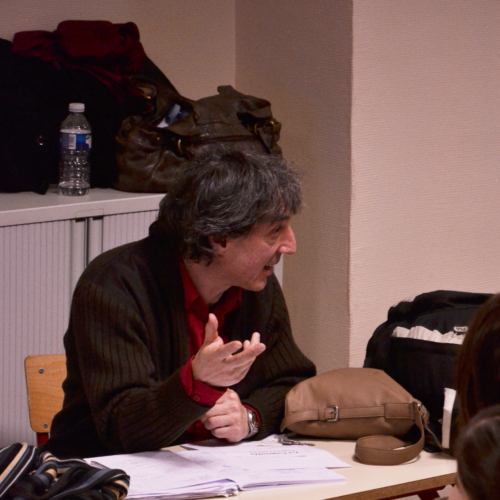
François has frequently led conferences and seminars. In French, with a small number in English.