
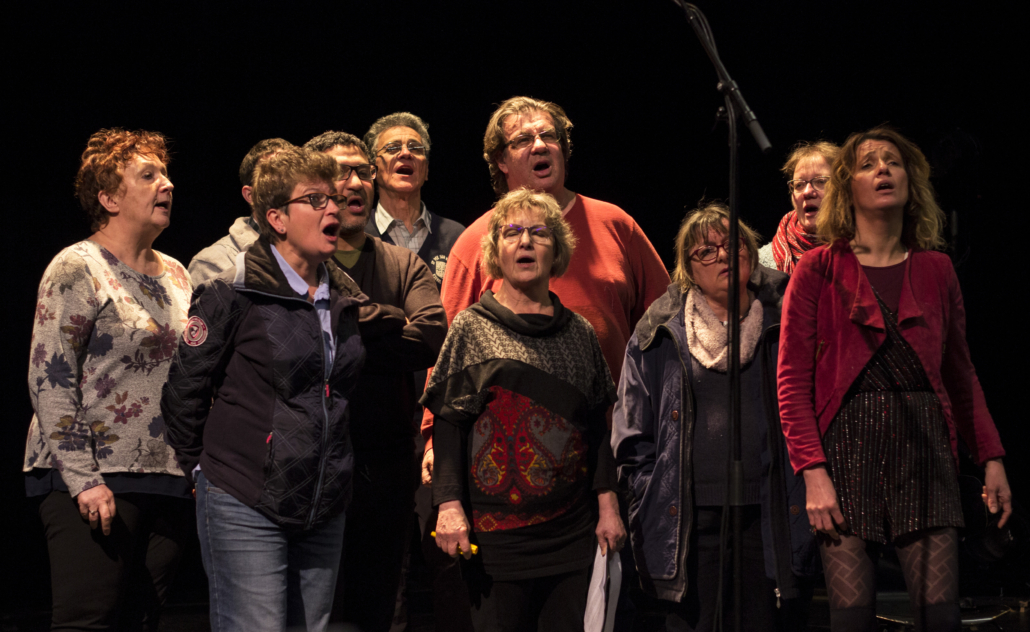
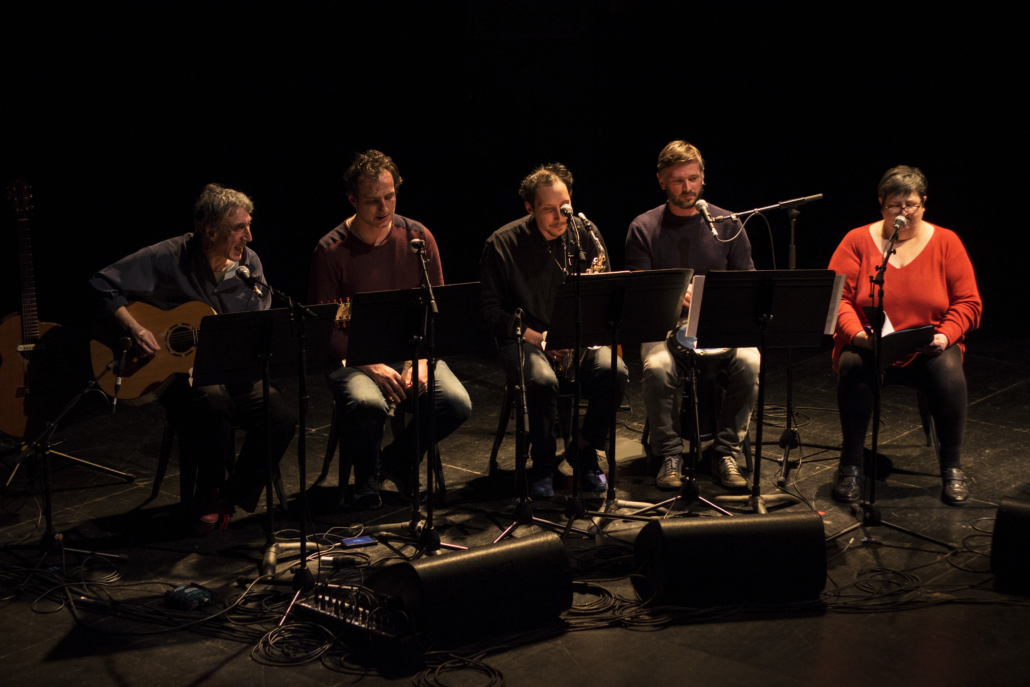
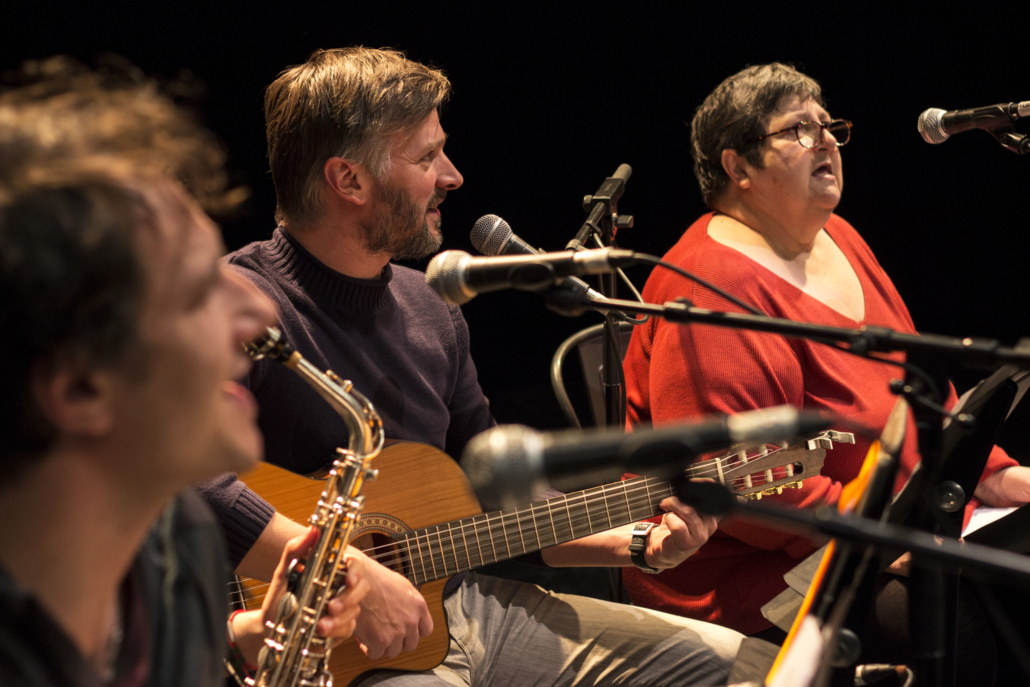
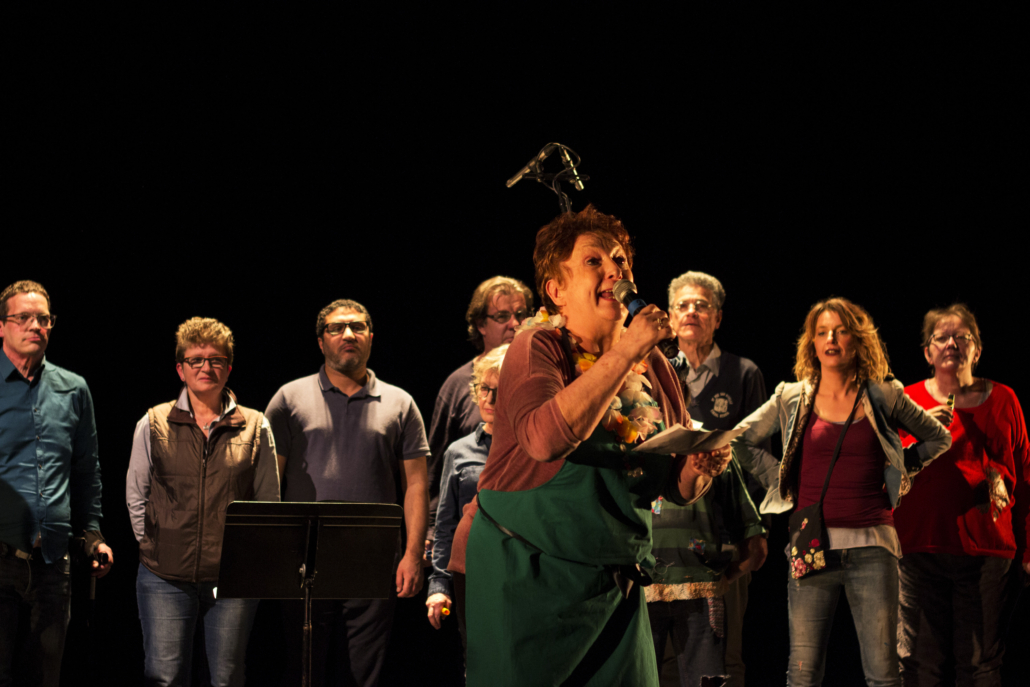
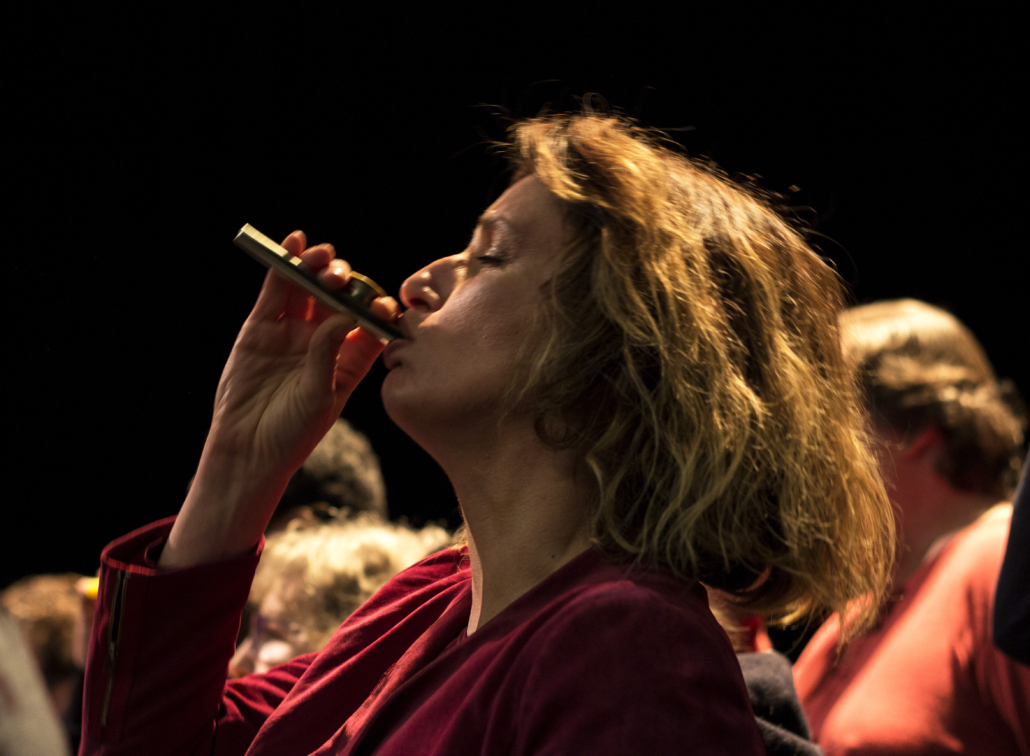




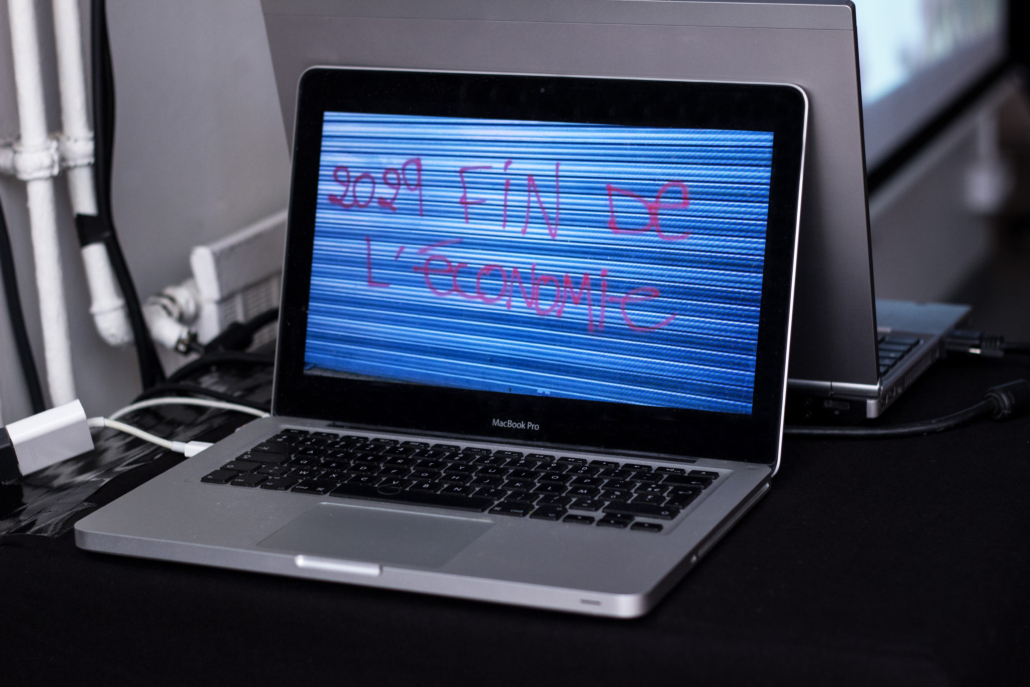

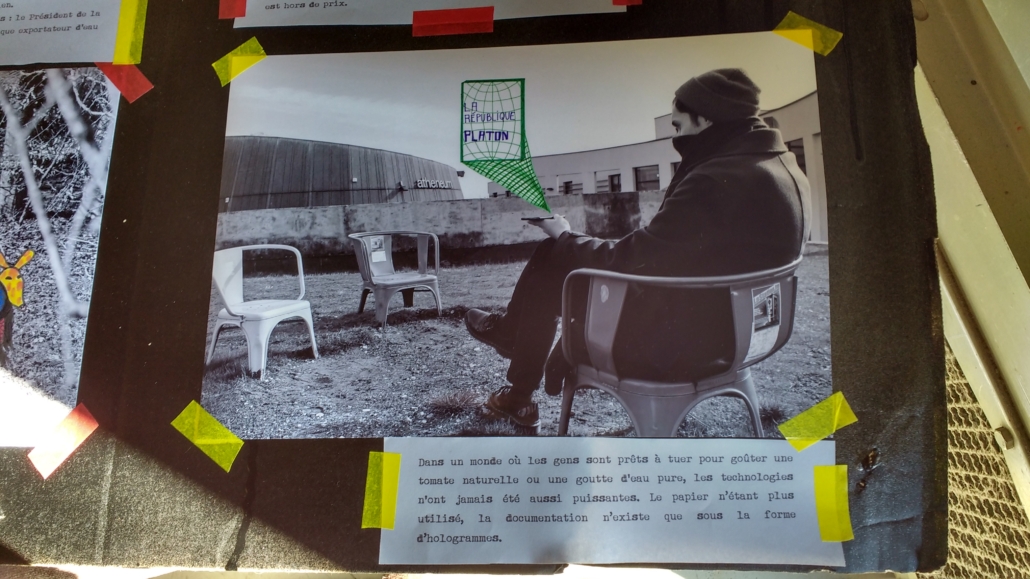
Photos Marion Boisard
Le Grand Orchestre de la Transition
Premiered during the Itinéraires Singuliers festival on March 20, 2019 at the Atheneum (University of Dijon theater)
A performance-exhibition featuring (musical) theatre, sound effects and installations
A collaborative project
In the Grand Orchestre de la Transition, various collectives of amateurs accompanied by professional artists envisioned the city of Dijon in 2039, after 20 years of global warming and (hopefully!) ecological transition. To achieve this, they used writing, theatre, song, sound installations, video and graphics. The questions they asked themselves varied; some sought to understand the state of biodiversity in twenty years’ time or what life is like in a parched world. Others imagined the soundscapes of a city where animals would have a greater place, and still others wondered how to forge alliances with the Earth’s non-human elements (minerals, air and water, subterranean creatures) and how to represent them, embody them, bring them to life on a stage. Beyond these (deliberate) differences, most of the groups not only anchored their work in Dijon but also in specific locations: the university campus (and in particular a building called “the Multiplex”), the Fontaine d’Ouche neighborhood, Lake Kir and the city centre. It is these spaces and the people and collectives, things and entities that will live there in 20 years’ time that have been portrayed and interpreted.
Just as the themes and media varied, so too did the time spent on conception and execution. Some groups set to work as early as October, others a little later, and still others worked for a short period of time and combined their ideas into a single proposal. In other words, the narratives, reports, descriptions, sketches and fantasies were fragmentary and sometimes even unfinished, perhaps a touch elliptical. The aim was not to provide an exhaustive portrait of Dijon in 2039, or to present the complete programme of the socio-ecological transition, how it might (or might not) unfold and what would follow. The ambition was simply to use artistic vocabularies, and in particular those of the performing arts and music, in order to sketch out new worlds, ensuring that this exercise in imagination was driven by the people who actually live in the area.
With the participation of patients and therapists from the Espace des Expressions Gaston Bachelard (Dijon), and students from the University of Dijon, the École Nationale Supérieure d’Art of Dijon and the Théâtre Universitaire de Dijon (TUD).
Presse
Profession-spectacle, 7 nov 2019
Anthropocene: can artistic and cultural practices change the world?
How can the cultural sector be powerfully engaged in the socio-ecological transition? This is the aim of the research project “Performing Arts and Music in the Age of the Anthropocene” (ASMA). At its core lies an act of faith: artistic practices would allow us to collectively carry out life projects that are more attentive to the biosphere. Explanations.
Led by François Ribac, the ASMA research project brings together major players such as the Cimeos laboratory, IRCAM, ADEME and the Burgundy School of Business.
A music-theater composer and sociologist, François Ribac is an associate professor at the University of Burgundy-Franche-Comté, where he has taught the sociology of culture and the performing arts since 2012. He is a member of the CIMEOS laboratory (Information and Communication Sciences). Author of several books including La fabrique de la programmation culturelle, co-authored with Catherine Dutheil-Pessin (La Dispute, 2017), he has been directing since 2016 the ASMA research project (Arts de la scène et musique à l’âge de l’anthropocène), which focuses on how the performing arts and music face ecological challenges: how does the socio-ecological transition manifest within the performing arts world, and what challenges do artists, programmers, and cultural experts face?
Profession Spectacle met with him to try to answer these questions and observe the impact of the issues raised by the Anthropocene on cultural practices.
Anthropocene and art: a beneficial crossbreeding
The book L’Événement anthropocène. La Terre, l’histoire et nous (The Anthropocene Event: Earth, History, and Us) by Christophe Bonneuil and Jean-Baptiste Fressoz, notes the critical socio-ecological state into which humanity has entered. “It is a founding book for me. It does not simply say that there are urgent matters and policies to question, but it also invites us to reflect on the history of modernity: if human activities have become a geological force, what becomes of the separation between nature and humanity?”
With an ecological sensitivity, François Ribac has incorporated issues related to the Anthropocene into his research on cultural and artistic practices. The Anthropocene is a scientific hypothesis according to which human action modifies the earth’s conditions to the point of acting as a geological force – via intensive agriculture, deforestation, industrialisation, the demographic explosion, pollution, the consumption of fossil fuels and the exploitation of nuclear energy.
“I thought it was time to cross disciplines,” explains François Ribac, describing his academic work as follows: “The imaginary of ecology is a central subject for me; the arts, which appeal par excellence to the imaginary, allow us to think about our world in a different way.” It is therefore possible to approach the Anthropocene through the prism of art while aiming of going beyond the mere use of the artistic message to promote responsibility, because the ecological ruin is today, according to the researcher, more than obvious. “Awareness of ecological disasters is now worldwide,” he insists, “we have rarely seen this in the history of humanity.
What Art Prompts Us to Consider
In his latest collaborative project, Le Grand Orchestre de la Transition (The Great Transition Orchestra), combining music, theatre, video and sound installations, presented in March 2019 at the Atheneum in Dijon, amateurs and professionals joined forces to tell the story of what their lives might look like after twenty years of global warming. “With various partners in Dijon, we cobbled together a framework where ordinary people, artists and researchers could imagine their future where they live, and observe how the performing arts and music could help shape—and allow us to listen to—the ecological transition.
In the current situation, it’s not just a question of getting out of fossil fuels or unceasing progress, but of imagining how we are going to live,” continues François Ribac.”A researcher like me cannot say: ‘this is how it will be’. The technique of social science research consists of carrying out surveys; I wanted my survey to use artistic tools. Art can allow groups to project themselves, to dream and to imagine the positive side of a change in the world.
What challenges for cultural experts?
The ASMA research project directed by François Ribac includes another major axis: extensive fieldwork conducted by various researchers. The work of some of these researchers is being presented as part of the “Sound of the Anthropocene” seminar series at IRCAM, with upcoming sessions scheduled for November 15 and 16.
“I carried out a survey on artist residencies in Burgundy-Franche-Comté, in collaboration with the cultural agency Le LAB – Liaisons Arts Bourgogne. I also conducted similar research in Berlin to compare with France, because citizen ecology is very developed in Germany: and found there are not so many differences with French places. The question of the Anthropocene was an underlying theme throughout. For instance, a Bob Wilson production in Berlin really struck me: it was a staging of Beckett’s Endgame, which ended with images of a bear falling into the water because the glaciers were melting. It surprised me because, if there is one person who avoids using anecdotal imagery, it is certainly Bob Wilson.
One of the general trends that François Ribac notes is the concentration of efforts on the users, when it is rather on the production side that the ecological cost is heaviest and that it would be really efficient to act. “Recycling, using short organic food circuits, using reusable plastic cups in theatres and festivals is undoubtedly important. However, it is important to look at production because without it, it is an alibi. Moreover, the relentless pursuit of novelty in cultural programming amounts to a form of planned obsolescence, the idea that you constantly need something new, an idea originally promoted by smartphone marketers.”
Artistic practices would thus make it possible to collectively carry out life projects that are more attentive to the biosphere. Like any idea of excess – whose energy cost leads to ecological ruin -, through art and thanks to work on the ecological imagination, other ways of living could be envisaged to imagine the future world.
Morgane MACÉ
Alternatives théâtrales July 29, 2021
The Alternatives théâtrales magazine blog
Le Grand Orchestre de la Transition
Preamble
This text presents a collaborative performance entitled Le Grand Orchestre de la Transition created for the Itinéraires Singuliers festival on March 20, 2019 at the Atheneum, the University of Dijon’s theater. The project was conceived and realised as part of the ASMA research programme (Performing Arts and Music in the Anthropocene, 2016-2019). Over a six-month period, different Dijon collectives imagined and then represented on stages the future of their city, following twenty years of global warming. Here, I focus in the musical theatre group that I led with my artistic partner, the singer and director Eva Schwabe.
Narratives, certainly—but which ones?
In the tremendous excitement of the current ecological galaxy, the ability to represent other paths than those of late neo-liberal (and increasingly authoritarian) capitalism is a crucial issue. Types of activism such as the Movement of Cities in Transition, the occupations of ZADs or the recent organisations Youth for Climate or Extinction Rebellion, numerous academic works and a myriad of artistic initiatives are exploring with their specific tools new ways of mobilising, of acting in territories, of reflecting on other ways of thinking about the world and of designing futures. Why? Because these movements have understood that ecological transformations cannot be limited to changes in infrastructure and energy. It is not enough to simply replace a boiler; we must change the world. Precisely in the artistic world, and particularly in the performing arts, many artists and institutions are trying to initiate new narratives, to tell stories in different ways. Even if it is impossible to list all the shows that are trying to do this, many of them convey general messages to the public. I am thinking, for example, of the musical Requiem, in which the director Romeo Castellucci combines Mozart’s work of the same name with a few other scores to evoke the extinction of the human race.
In a similar way, many musical projects try to make concepts such as the Anthropocene, pollution and the climate emergency understandable. Rather than discussing the aesthetic quality of these performances, what is questioned here is the off-the-ground and general nature of this approach.
Indeed, many past and present experiences—from the struggles of Japanese farmers against the establishment of mines to the recent Yellow Vests movement—have taught us that environmental injustice does not affect all humans in the same way; impacts vary depending on where one lives, one’s social status and gender, and whether or not one is racialized. While the human species does share a common destiny, individuals are neither threatened nor—even less so—responsible in the same way. Similarly, the rise of the figure of Greta Thunberg and movements such as Youth for Climate have shown that today it is less a question of alerting people to environmental perils than of demanding that governments and international institutions take real action. From this perspective, the main responsibility for ecological disasters lies with the (often transnational) companies that exploit the world and plunder poor countries rather than with individuals.
Finally, it is worth noting that the performances alerting us—sometimes with great skill—to global perils are most often created by artists and professional networks whose reputation and renown are inversely proportional to their connection to a specific locality.
In contrast to an off-the-ground approach focused on explaining concepts and placing responsibility on individuals, the Grand Orchestre de la Transition project set out to envision futures rooted in a specific territory—futures conceived, narrated, and staged by the collectives living there. Rather than staging the disaster, the idea was to represent and make common spaces heard. We therefore proposed to collectives to imagine their lives in 2039, after 20 years of global warming, and to conceive and tell all this with artistic vocabularies, in particular music and theatre. We therefore invited collectives to imagine their lives in 2039—after twenty years of global warming—and to conceive and tell that story using artistic forms, specifically music and theater.
The Sections of the Grand Orchestre de la Transition
Following a series of meetings with various organizations in Dijon, as well as calls for proposals and external outreach, the team for the Grand Orchestre de la Transition takes shape in early autumn 2018. It comprises five collectives.
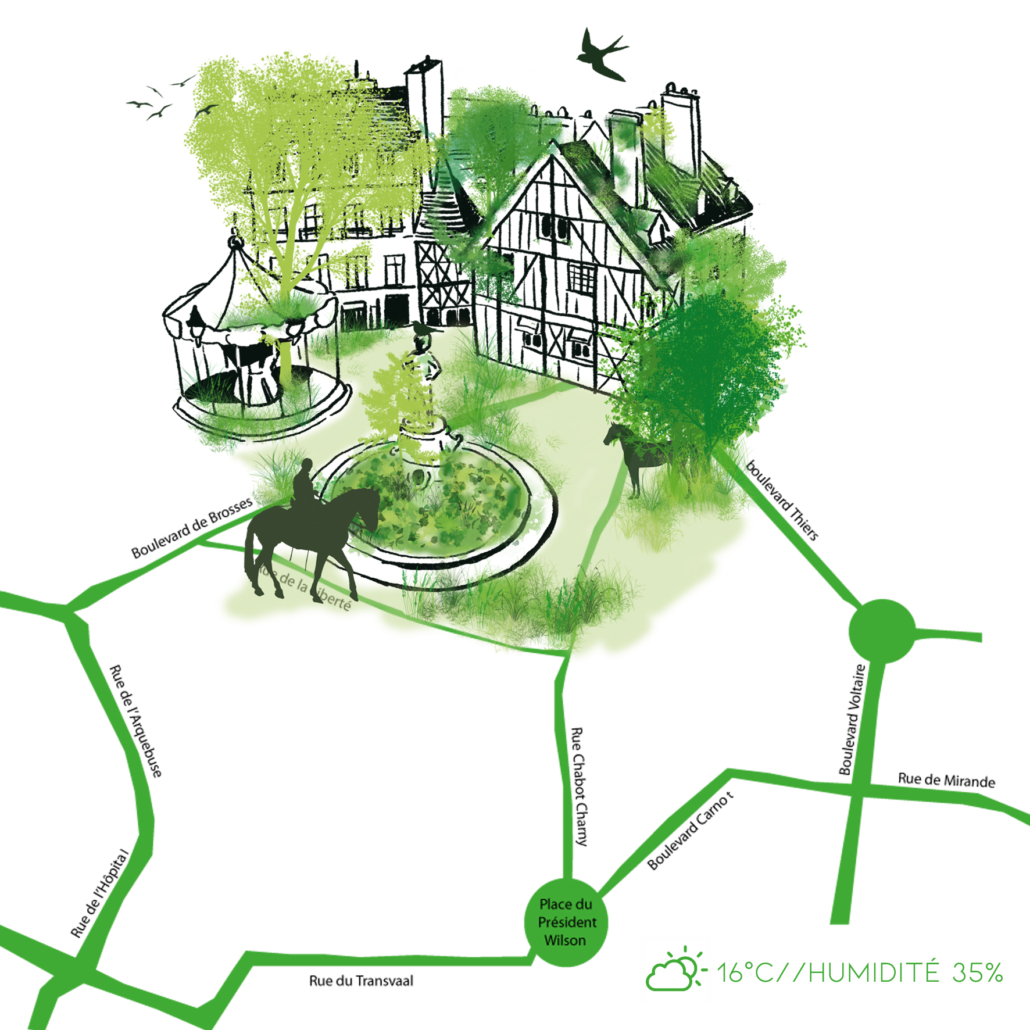
– About fifteen students from the École Nationale Supérieure d’Art de Dijon (the former École des Beaux-Arts), accompanied by Nicolas Thirion – a composer and head of the Centre national de création musicale de Dijon Why Note – and Jean-Christophe Denoux, a composer and teacher at the school. We asked them to imagine the soundscapes of a specific part of the city center as it might exist in 2039, providing them with a map showing selected streets and squares in that area. At their first meeting, the group decided to record sounds outdoors and to use sound-creation software.
– The second group consits of patients and therapists from the Centre Bachelard des Expressions, an art therapy service in the psychiatry department of the Dijon University Hospital. With its own dedicated facilities and a specialized team, the Centre offers individuals suffering from mental health disorders the opportunity to participate in collective artistic workshops. Its director, Alain Vasseur, is also one of the founders and organisers of the Dijon festival Itinéraires Singuliers, which is dedicated to art brut and the fight against exclusion. The Grand Orchestre de la Transition will be presented during the festival. The Centre des Expressions is located in Fontaine d’Ouche, a working-class district hastily built at the end of the 1960s on the outskirts of the large Kir lake and a major park. This is the area that will be imagined by this group in 2039.
– A theatre group from the student association of university theatre in Dijon (TUD) has been specially assembled for the project.Comprising four students, a young waiter and a photographer, the group is led by Didier Doumergue, a director from Metz with long experience working with amateur performers. This group decided to set their stories on the University campus in the year 2039.
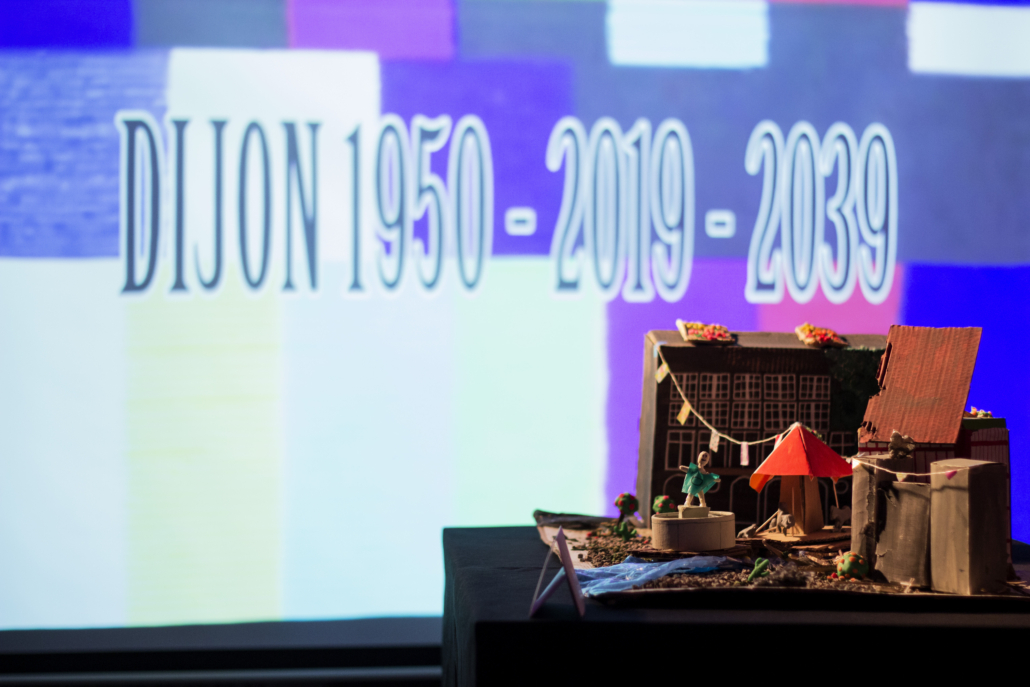
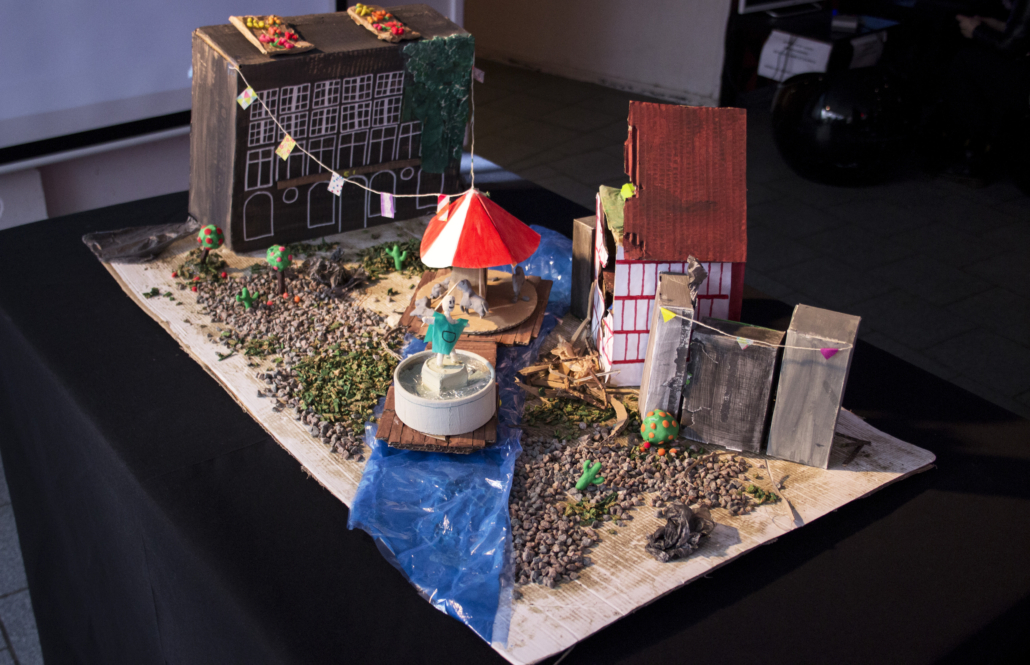
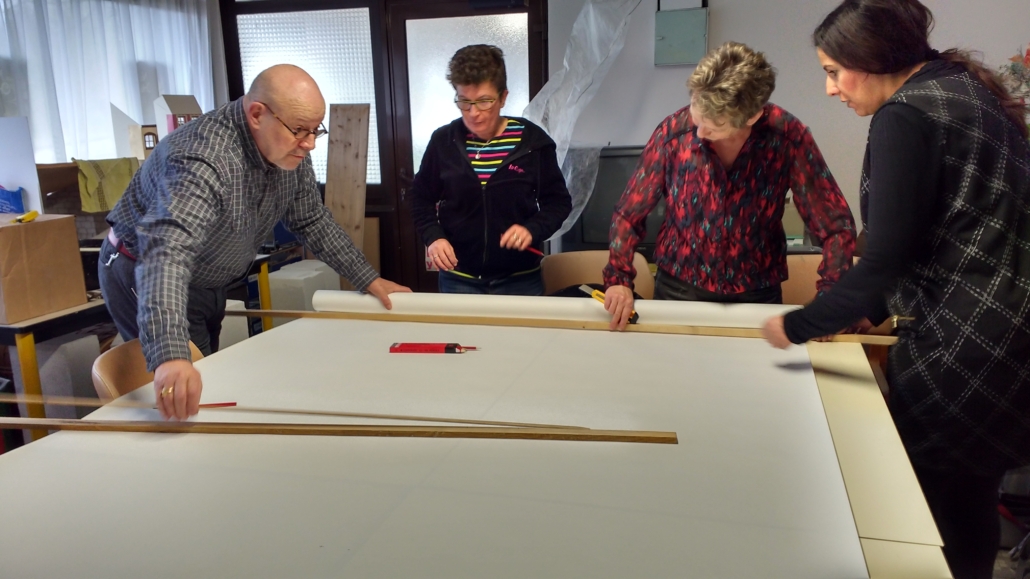
– Around twenty students from a university master’s program specializing in performing arts professions are working with Marielle Nidiau-Bourdot, an “artivist” who teaches graphic design within the program. This group will create plans, models, installations and videos about the three districts where the actions are taking place.
With these five groups, the project has about seventy people between the ages of 20 and 70, is roughly equal in number and includes visible minorities. Music and theatre are in the limelight, but also visual arts and documentaries. The team of professional artists comes from a variety of aesthetics and is also equally divided. Finally, the three areas of the city – campus, Fontaine d’Ouche and city centre – that will be investigated are very different. Some of the participants live there, others work there, others go there to carry out activities. In this text, I will focus specifically on the musical aspect of the project and the collaboration with the art therapy center.
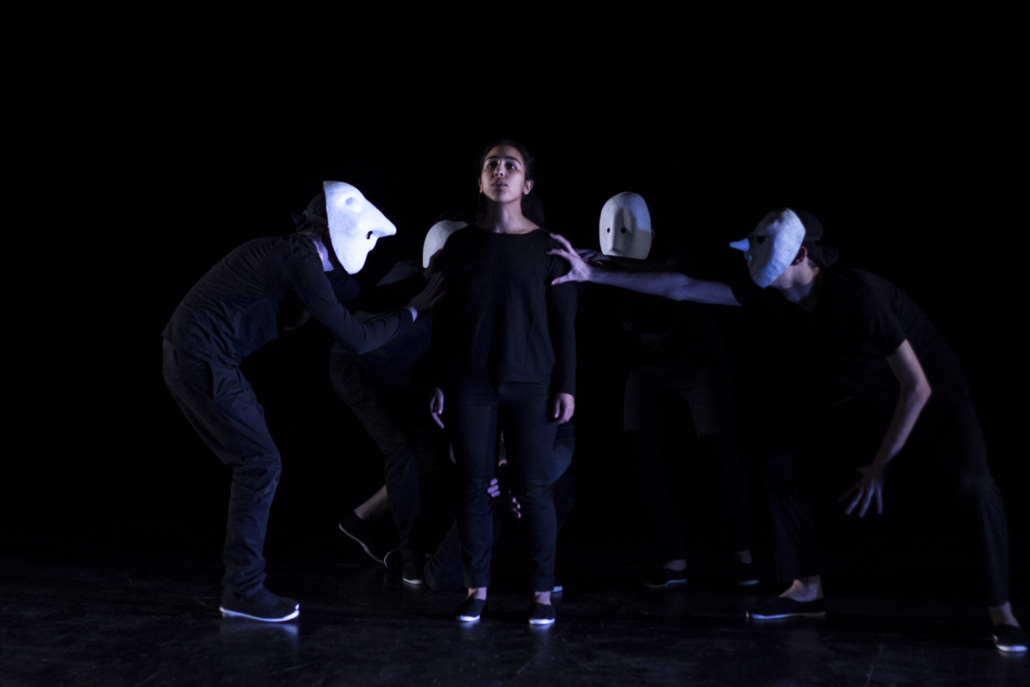
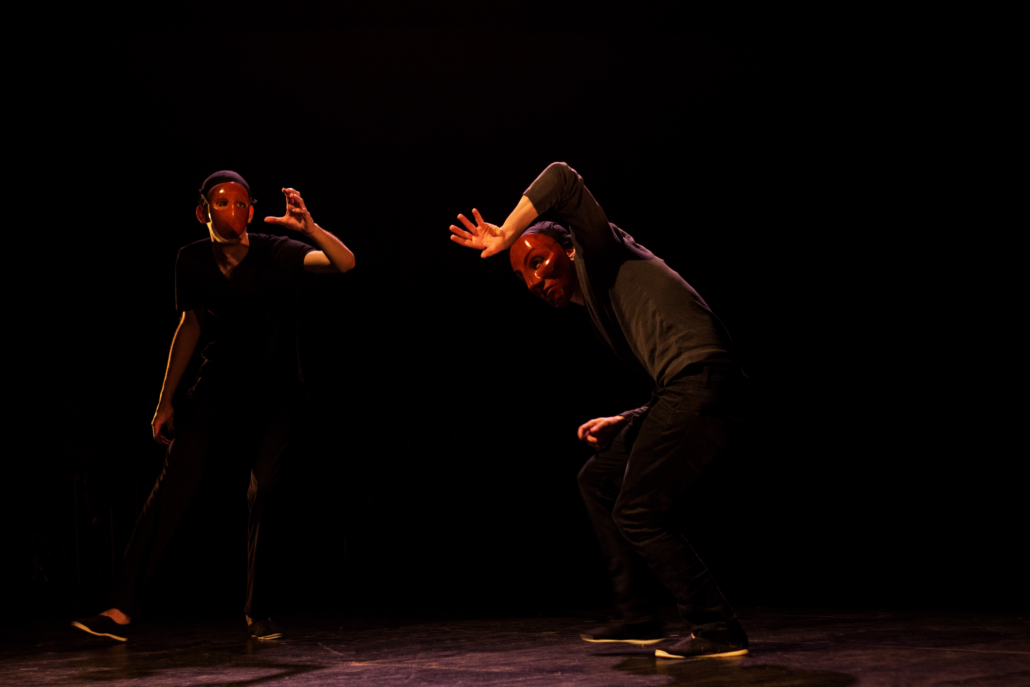
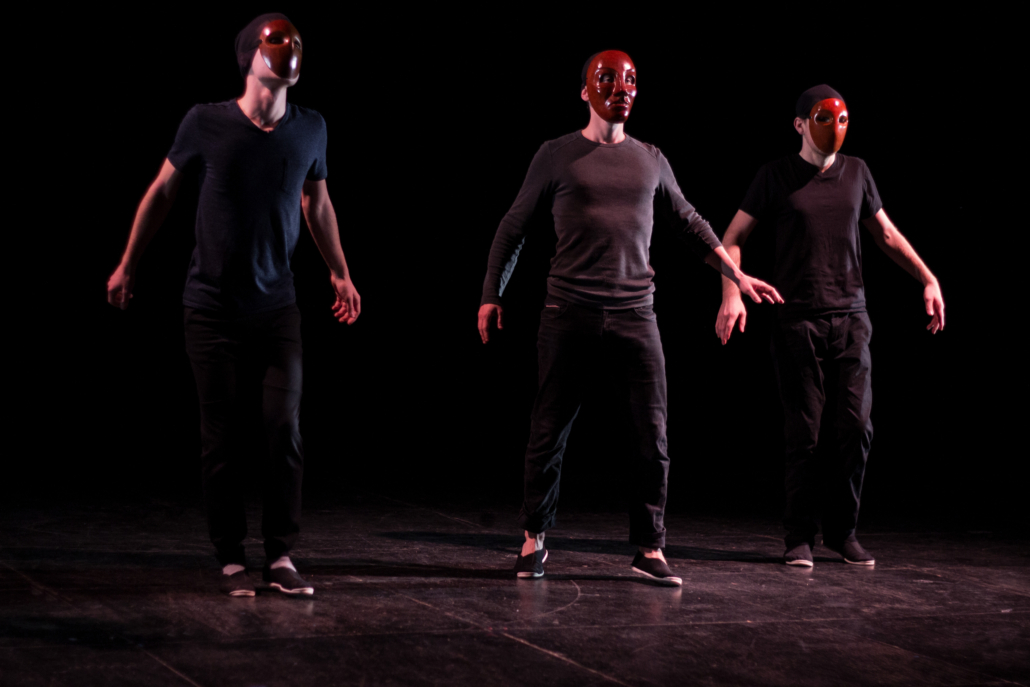
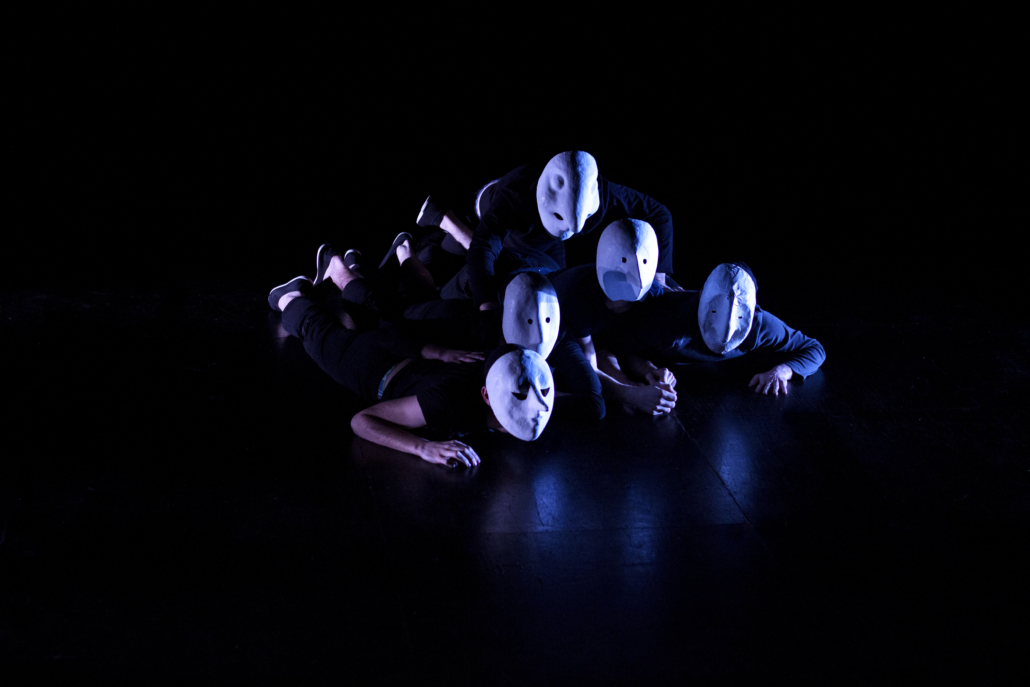
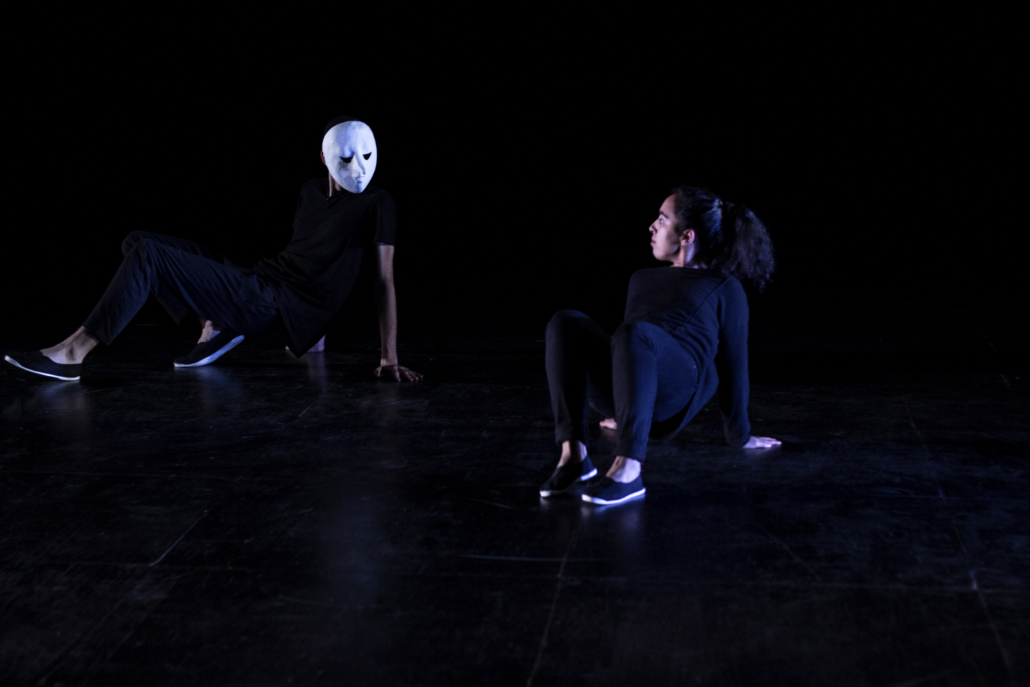
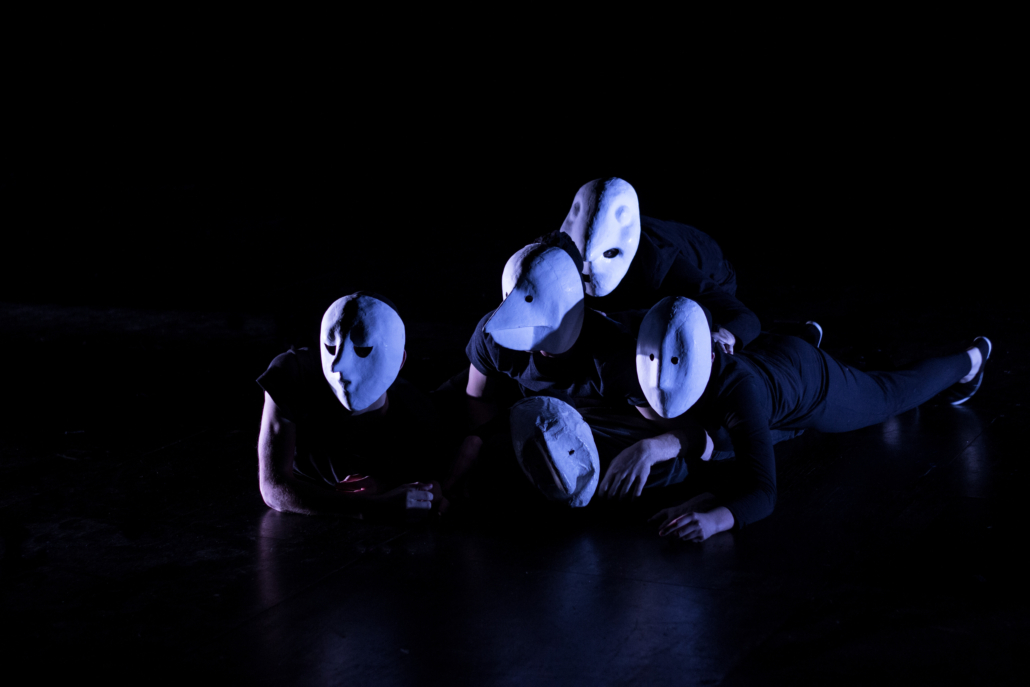
Les masques neutres. “Le Grand Orchestre de la transition“ a play written by the actors and directed by Didier Doumergue, Théâtre de l’Atheneum, Dijon, 20 March 2019. Photo: Marion Boisard.
The Bachelard adventure
Eva Schwabe and I worked for six months at the Centre Bachelard. We first presented the Grand Orchestre de la Transition project to the team of caregivers and then to the patients who wanted to get involved. As I mentioned earlier, we asked them to imagine their own lives and those of the residents of the Fontaine d’Ouche neighbourhood in 2039, after twenty years of global warming. People seemed a bit taken aback at first, yet interested nonetheless… .. So we set to work straight away with the support and kindness of the team of therapists – who all practice artistic activities within the structure – and the other people at the centre. The “Bachelards” were divided into two groups.
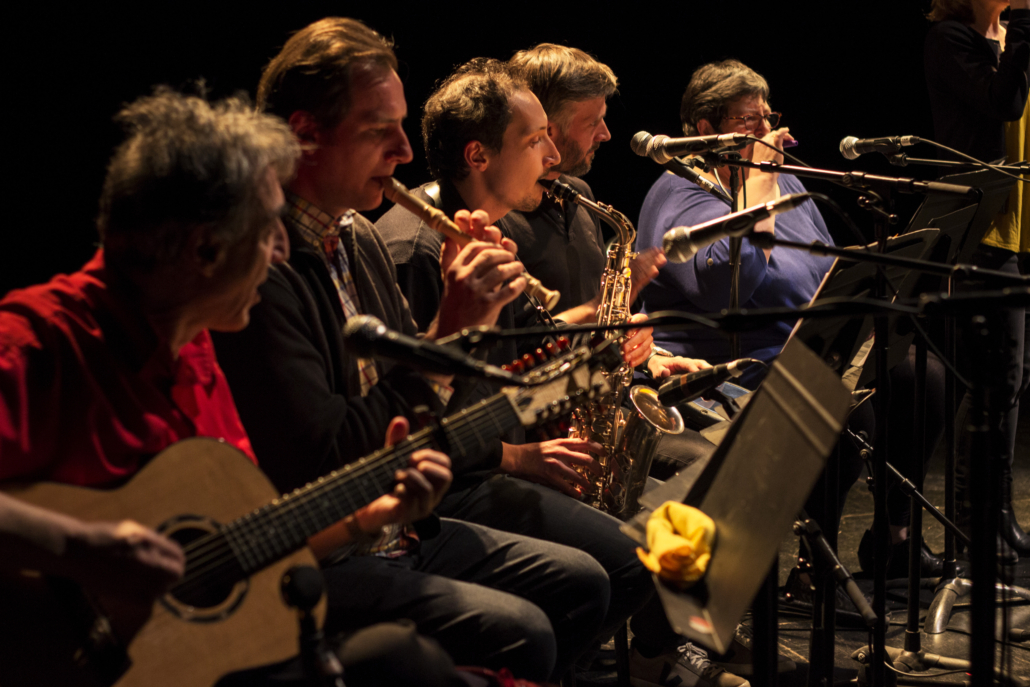
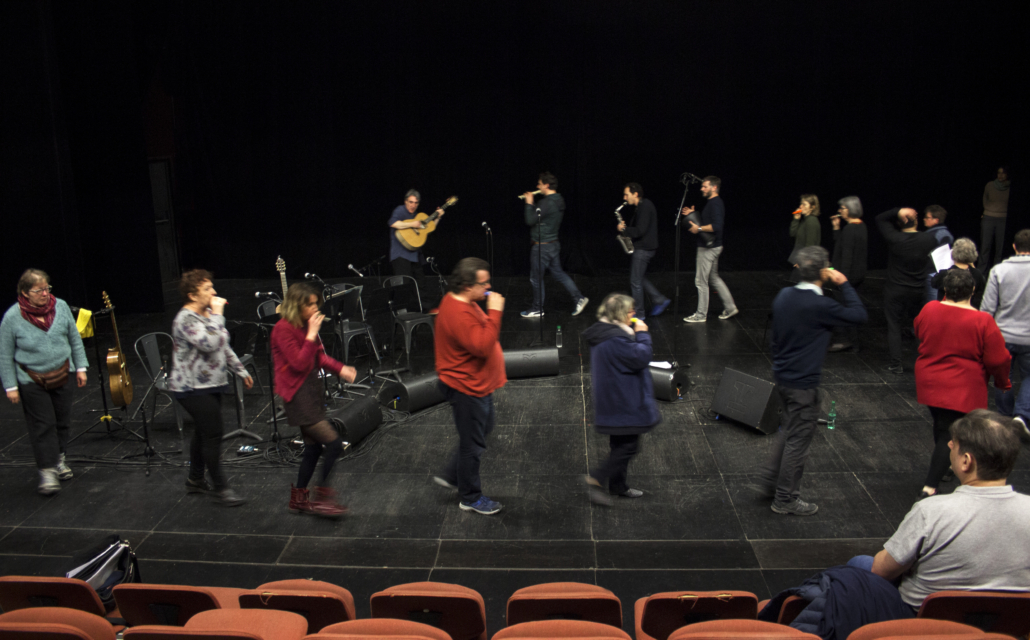
First, a choir of about twenty people and a small orchestra ( saxophone, flute, two guitars, percussion) composed of two patients, a music therapist and myself. A second therapist took part in all the rehearsals within the choir.
Second, a writing workshop and, more occasionally, a plastic arts workshop. It consists of about ten people and is accompanied by one of the two art therapists from the Bachelard centre and by Eva.
The writing workshop
This workshop brought together about ten people, some of whom also participated in the choir. It worked for about three months and produced all kinds of texts.
During the first few sessions, some of the participants initially found it difficult to find a space to express themselves. Global warming and its consequences – drought, the drying up of the lake and its water reserves, the disappearance of animal and plant species – blocked the imagination a little. The first chronicles, often written in the first person, described a gradual collapse of the neighbourhood and the town and the increasing atomisation of the people. However, part of the group immediately appropriated the theme of drought and wrote poems and songs that connected it with emotions, states (e.g. nostalgia for the old world or the joy of facing adversity together). Three of these texts were adapted into songs by three composers of the musical group: the music therapist, a patient and myself. After a few sessions, the text proposals started to be more and more abundant and diversified: stories about the creation of communities, their efforts to endure, their tearing apart and splits. Other stories described the construction of huts by families, vegetable gardens, mountain excursions, impromptu meetings. Some chronicles documented non-human entities emerging from the dry soil of Lake Kir and settling there. What struck us then was that in many of these narratives, the people, animals and wildlife that managed to survive migrated into forests or lived away from the dry lake and the neighbourhood. The neighbourhood high-rises, shopping centres and streets were abandoned. After a few weeks, a story set in the heart of the neighbourhood was proposed. Un matin de bonheur, a long text written by Joseph, was acclaimed by the musical group, including the therapists. The text, a jewel of art brut in my opinion, describes the encounter between Alberte, a gardener and irrigation expert, and her dog Hector, on the one hand, and a demonstration of animals and plants protesting against the destruction of the planet by humans, on the other. There are bushes trailing along the pavement, processions of snails and slugs, protesting trees, delegations of wild animals with an earthworm as spokesperson. The text almost explicitly refers to the Yellow Vests revolt, and we see a complicity between Alberte and her dog and the protesters. At the end of this meeting, the procession sets off again to attack the official representations of power, in short, it frames its anger. Un matin de bonheur was set to music in the style of a radio play, with sound effects produced by the choir, instrumental and choral sequences, dialogues and some stage movements. All characters and sounds were created live by the choir and the orchestra. The nature that unfolds is ordinary – earthworms, snails, trees and the like – it is nonetheless rendered extraordinary by the poetic power and humor that permeate the text. I was the one who set the text to music.
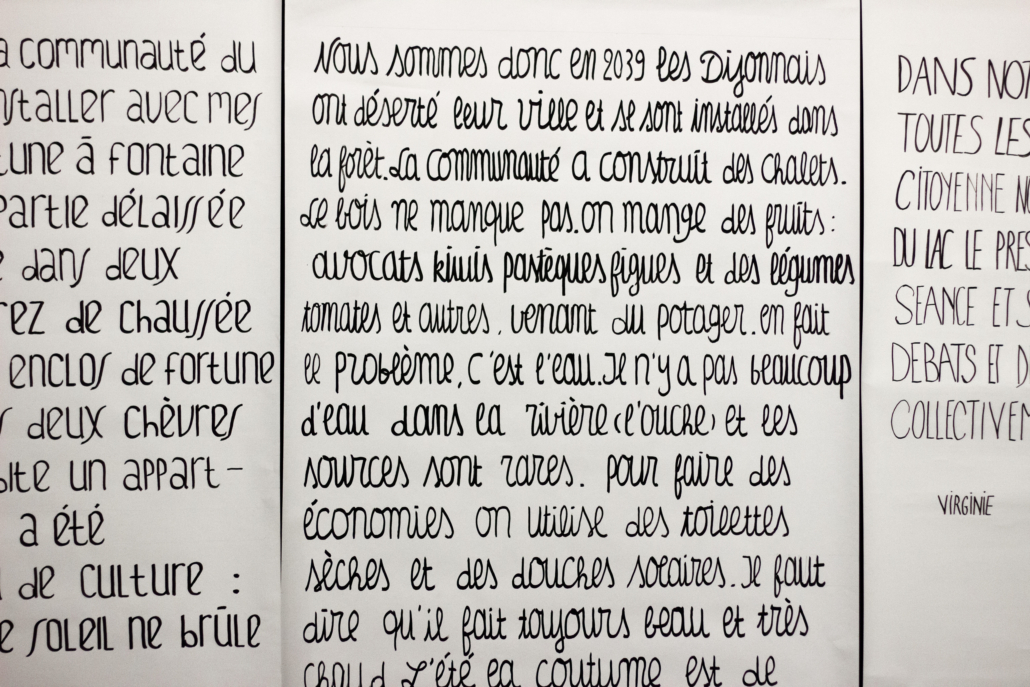
To summarise the productions of the writing workshop, we can say that different forms of mutual aid, resilience and various forms of life have gradually replaced the survivalist or extinction narratives. The writing group proposed and explored a wide variety of situations, relationships to the overheated territory, a vast panorama of alternatives and ways of living together. It did not evade conflicts between humans and instead presented the natural world as a benevolent force. Significantly, Joseph’s text equated the environmental issue with injustice and dramatised the things and beings that were victims of it. Many members of the group repeatedly subscribed to this register of protest. Yet, it is also worth noting that several texts detailed inner states and focused on making the words themselves ring out and dance. What also struck me was that most of the participants immediately adopted the constraint of locating the actions in the Fontaine d’Ouche neighbourhood, even though they did not all live there. It therefore seems that this agreement supported creativity and the development of imaginary ideas. While we regularly suggested themes (e.g., “today let’s work on this or that”), many texts—Joseph’s included—were produced independently of our prompts. Shortly before the show, we also chose about ten of the texts to read as an introduction to the show. Several of the texts were also copied/calligraphed onto large canvases and assembled on the stage to make a large stage curtain.
The music workshop
While the writing workshop consisted primarily of individual work, the music workshop functioned essentially as a group. In Bachelard’s (very) small music room, every rehearsal began with vocal and physical warm-ups led by Eva and performed by the entire group. With the exception of some parallel score-reading sessions by the orchestra, the musicians and choristers always worked together. When instrumentalists were not playing, they would sing and/or could also play a character in the radio play. Similarly, the choir would play some percussion or kazoos during the animal‘s demonstration. Following the warm-up, the music sessions were led by myself, Eva Schwabe and the music therapist.
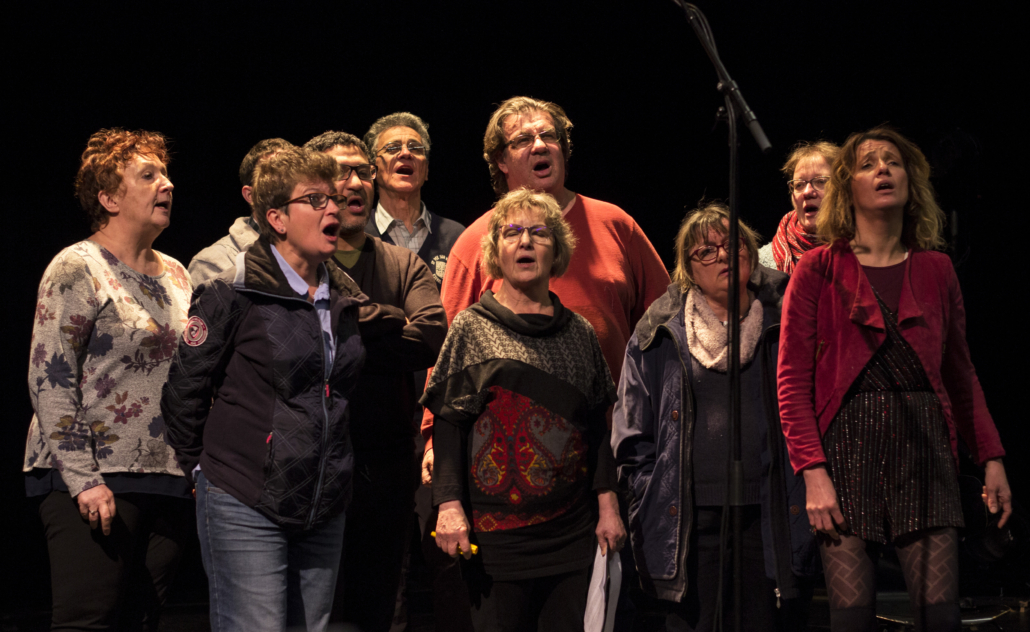
In the first session I auditioned each member of the choir to understand their vocal range and timbre. I immediately realised that some people had difficulty reproducing the notes I asked them to sing. Sometimes they were completely unable to do so. Similarly, although most of the participants sang regularly in the choir, the sense of rhythm and the perception of the pulse often seemed to be hesitant for many of them. Beyond the “musical aptitude”, several people were rather slow, even almost catatonic or sometimes frightened, some did not stand up during the songs or the training, several seemed tired and/or weakened by their medication. So we wondered at the beginning of the rehearsals whether people who in many ways were experiencing personal collapse could imagine and interpret ecological collapse. Nevertheless, the group also possessed a certain resilience and experience. Most people had been singing in the choir for months or even years, the musicians were serious and technically proficient, and almost everyone knew each other. Whenever someone seemed to be struggling, they found help and support from the others. After a few weeks, we could clearly feel a double dynamic developing. On the one hand, some of the most fragile and silent participants began to take their place, to take the initiative, the group became more homogenous and its capacity for concentration improved greatly. On the other hand, the musical level was clearly raised. The notes came out, the rhythms became more assured, the bodies swayed, the enjoyment of playing music and the meaning of the texts permeated the group more and more. Some choir members were doing things that no one—not even they themselves—had thought possible just a few weeks earlier, and the same held true during the performance. Confidence was present, and it carried the group. In the final weeks leading up to the show, and despite mounting pressure, rehearsals became joyful and highly productive. In accordance with the ‘doctrine’ of the Bachelard team, working as a collective and immersing ourselves in the artistic project allowed the whole team to put aside their illness. Imagining shared futures has, in a way, allowed us to break out of our isolation.
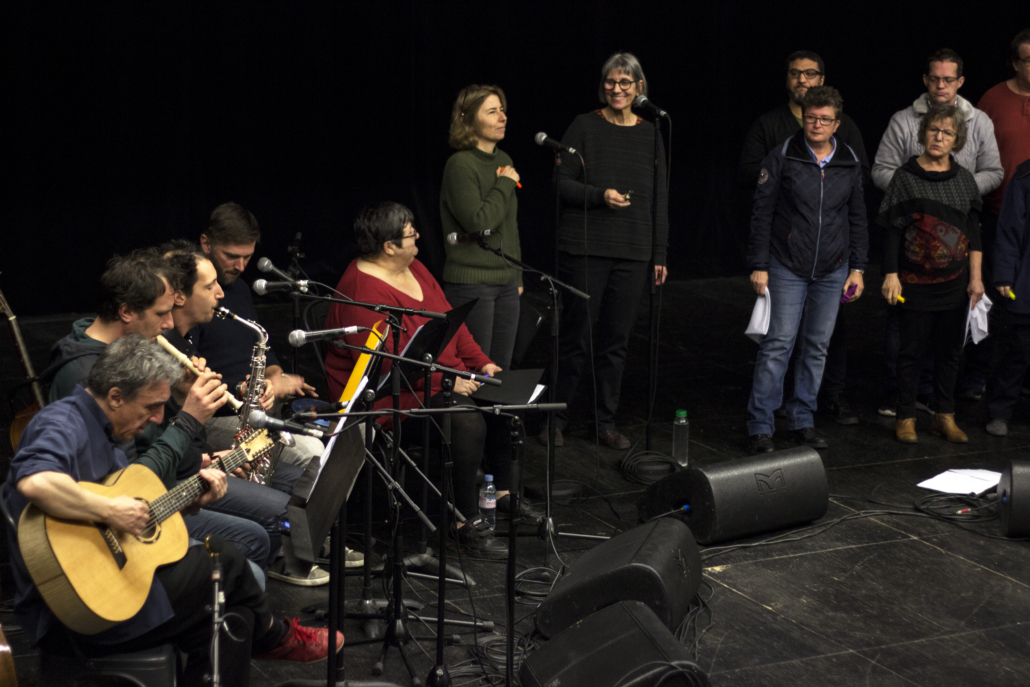
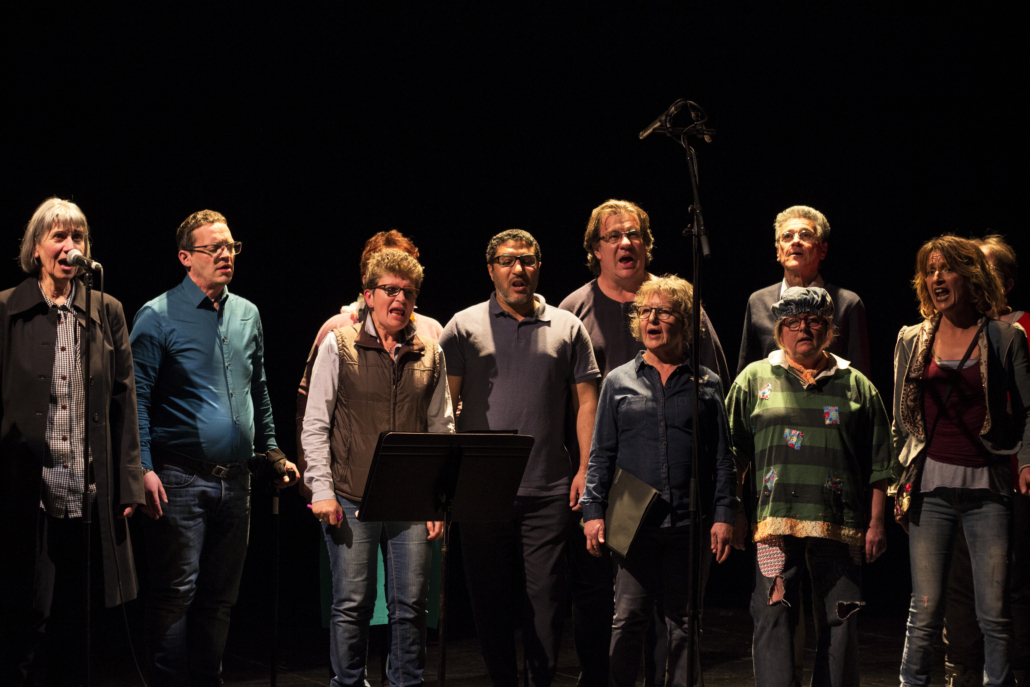
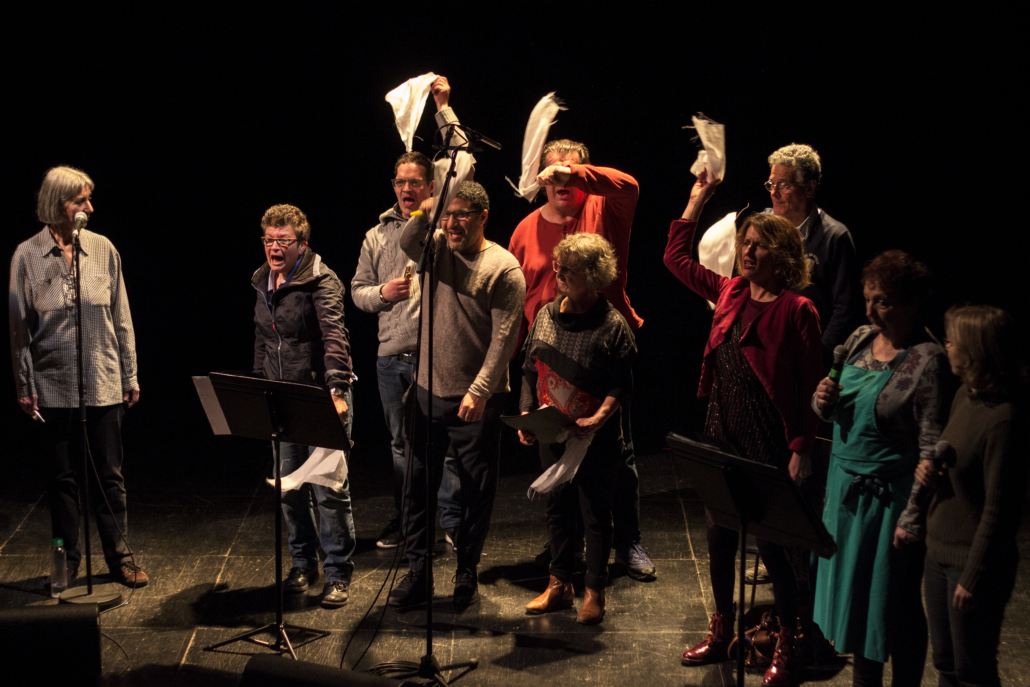
The orchestra and choir in action: *Le Grand Orchestre de la transition“ with texts written by patients at the Espace des Expressions Bachelard (Dijon) and music composed by François Ribac and Alban Malliet. Théâtre de l’Atheneum, Dijon, 20 March 2019. Photo: Marion Boisard.
The show
Final preparations
20 March 2019, 2 p.m.: the technical team and volunteers are setting up various supports – tables, display rails, video screens – , ensuring that the mixing consoles, computers and projectors are supplied with electricity, taping down the cables and securing tables, then draping the various elements in brushed cotton fabric. At the same time, students and a teacher from the École Nationale Supérieure d’Art de Dijon are busy in the hall of the Atheneum theatre and an adjacent room. They are also setting up speakers and bluetooth systems in the hall and in the corridors leading to the theatre and testing the console that will be used to mix live when the audience arrives in the hall. Loudspeakers will also play music in other common areas. The soundscapes highlight the animals inhabiting the city in 2039—both the visible and the invisible—from the birds that have taken over abandoned buildings to the rats and other creatures populating the city center’s derelict parking garage.
In this hall, the spectators will discover the various elements (installations, videos, sculptures, models, posters) of the exhibition designed by the performing arts students. A small map of the three districts of Dijon imagined by the groups will be distributed to the public. In an adjoining room, bathed in semi-darkness, a webdoc is already being broadcast on a loop. We can see and hear scientists, urban planners and activists describing the metamorphosis of Dijon in 2039. All the speakers speak in the present tense, as if the interviews had actually been conducted in 2039. Topics include the shifting of animal species, the insufficient vegetation in the city center, residents getting around by bicycle—in short, the urban planning aspects of the city, and so on.
At the end of the afternoon, the Bachelard group arrives in clusters, closely followed by the theatre group. Around 6pm, everyone participates in a vocal and physical warm-up on the stage. We give our final instructions and everyone heads back to the dressing rooms to take care of their costumes, tune their instruments, revise their lines, check that all their props are in the right place, and so on. The tension and excitement builds up as the group gets ready to perform. Tension and excitement are mounting. The stage has already been set up since the day before, after the dress rehearsal.
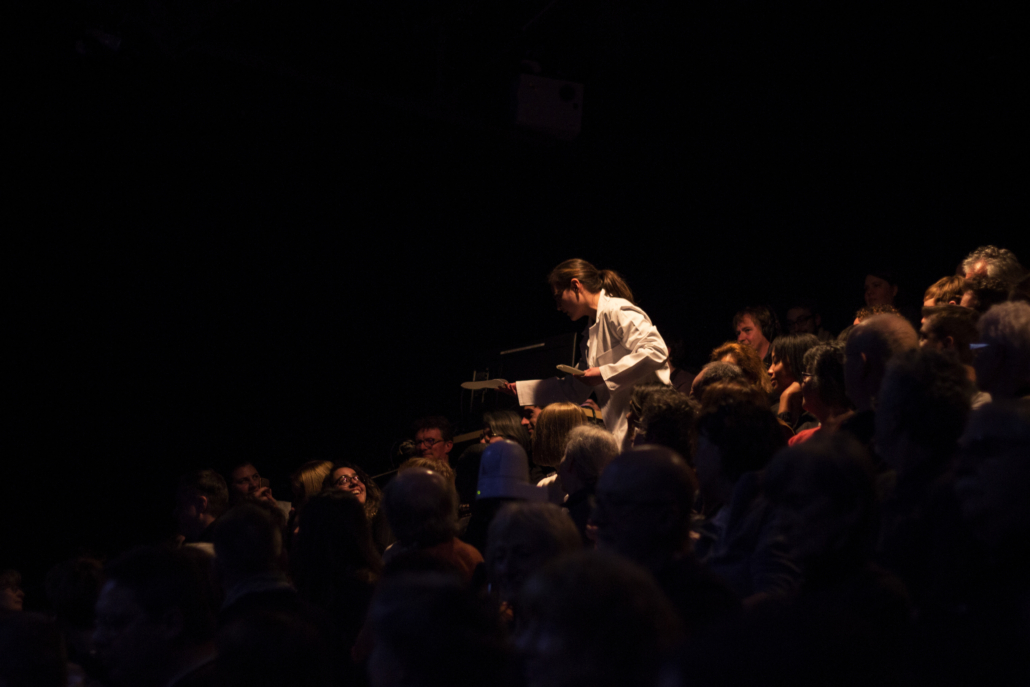
Around 7:30 PM, the first audience members arrive and begin to wander through the hall, exploring the small exhibition. Gradually, the crowd grows denser. The theater staff—sensing that the 200-seat capacity will be insufficient—begin counting the spectators. By 8:30 PM, dozens of people are being turned away; the house is full! To reach the auditorium, the audience passes through a narrow corridor filled with echoing soundscapes—though can they even hear them amidst such an incredible crush? The show is about to begin.
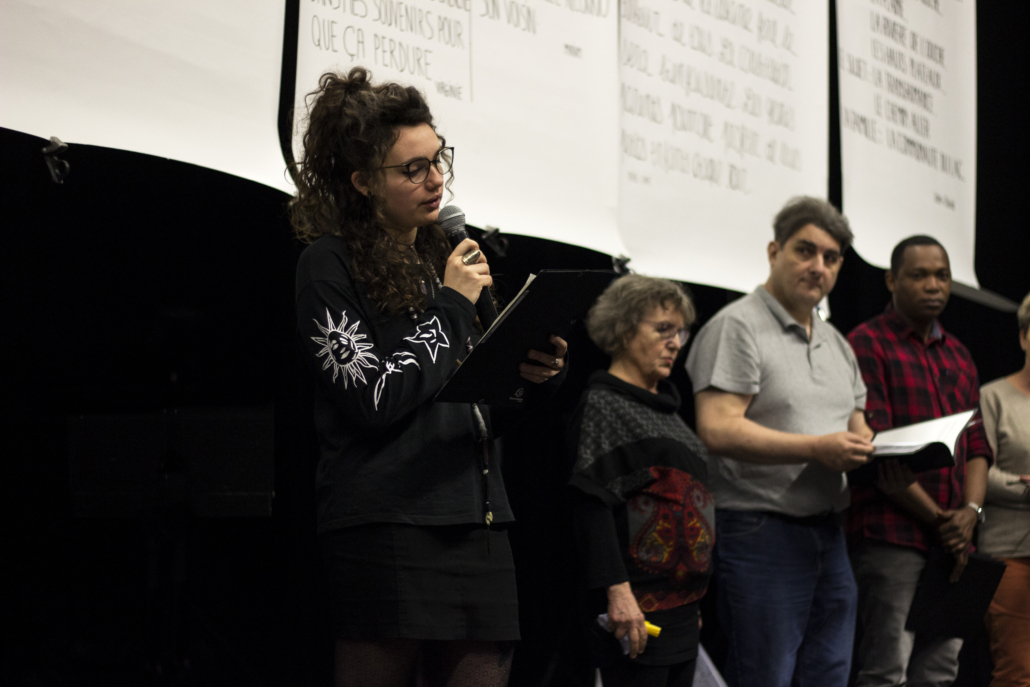
Readings
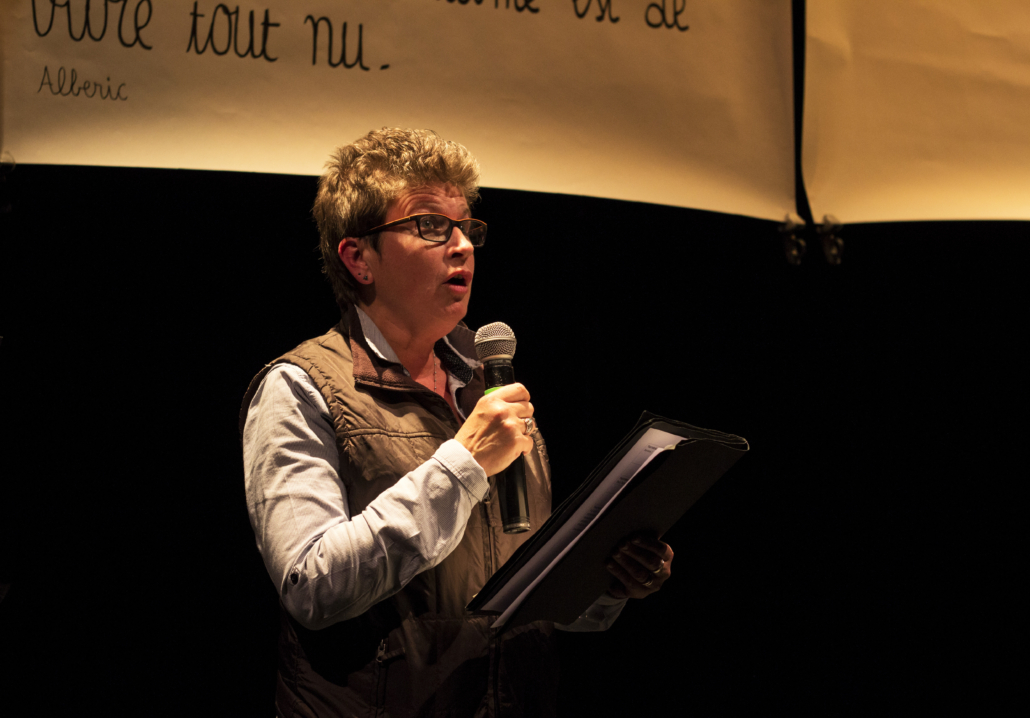
The first two parts of the show are devoted to the work carried out with the patients and caregivers of the Bachelard centre. Once the audience is finally seated in the auditorium, a warm light gradually rises over a large curtain of texts. The curtain is about three metres high and its width practically covers the twelve metre opening of the stage. The panels were patiently calligraphed in one of the workshops at the Centre Bachelard, and then fitted by technicians so they could be attached to the rigging bars and raised or lowered. The texts were created during the writing workshop and some are read by their writers, an art therapist and a trainee. Other participants in the writing workshop did not want to be on stage but they are in the audience. The group rehearsed a lot so that the reading would be fluid, so that the texts would follow one another and give voice to the variety of writing and singularities that are expressed. The audience is attentive and concentrated, I relax backstage.
The concert
The curtain of text rises towards the grill, the instruments and music stands appear on the stage and the musical ensemble settles down to take over. First we perform a short song “aïe aïe aïe le lac est presque sec” written in the writing workshop. After that, we start the radio play written by Joseph in the writing workshop, which was unanimously approved by the group. Alberte, her dog Hector and the demonstration of animals and plants sing, bark, chirp and laugh in front of the full house. I wonder if the people of Dijon recognise the Fontaine d’Ouche district as it has been played by the group. At the end of the play, the orchestra gets up and marches with the choir on stage. The humour and extravagant virulence of the text make it a kind of large animal orchestra in small format. We end with a nostalgic song, “Yahou”, composed by the music therapist and one of the patients. The performance is a little more tense than the general performance – which was a lot of fun – but the result is as good as we expected. The audience seemed delighted and called us back. They applauded several times during the presentation. An intermission allows for a change of stage and the theatre group to take their place. During the changeover, the students of the École Nationale Supérieure d’Art de Dijon and the two composers walk around the audience with small bluetooth boxes that play insect music, the audience is immersed in blue light.
The theatre group
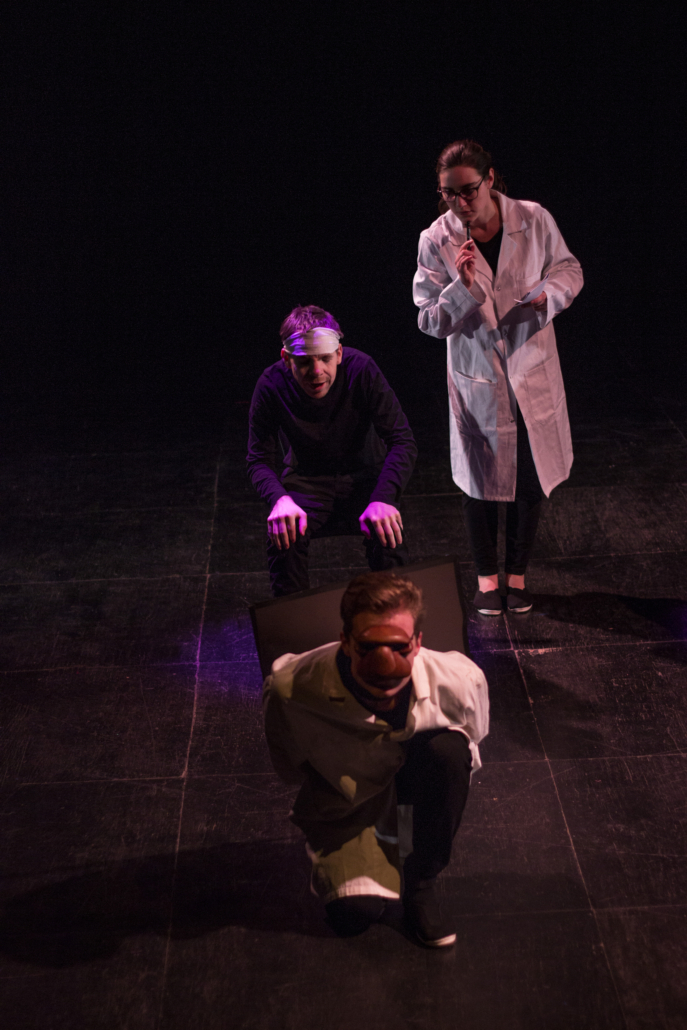
Then the actors begin their performance. It begins with a prologue where we learn that all the characters will have the same name, Sébastien, and that the action takes place mainly in the multiplex, a building on campus, located just a few steps from the theatre. We first discover characters wearing neutral masks (dancing and twirling in space). Then several scenes follow: the dispensary where we learn that the outside light is so strong that it is compulsory to wear a mask over the eyes and that a mysterious fatal disease affects certain students, a sort of general assembly where horses parked near the University talk about their condition and their relations with humans, a ballet with other neutral masks, even less anthropomorphised than the previous ones. Only one young woman, unmasked, attempts to communicate with these strange entities dancing around her. In my view, this is the most powerful moment. The conclusion sees the group of students confronted with a sort of Balinese devil – another mask – who rants about the responsibility of each of us towards the planet. The play ends. The audience applauds loudly and “bravo” is heard. After the bows, the hundred or so people involved in the project gather for a festive (vegetarian) dinner. The project comes to an end.
What turning it into a narrative offers us
I would now like to draw a few lessons from the Grand Orchestre de la Transition.
A variety of media and experiences
While sound and performing arts took center stage during the project’s preparation and the final performance, other forms of expression were also employed: poetry and storytelling, video, small-scale installations, city maps, documentary work, and large calligraphic posters. Rather than offering a single, definitive description of each of the three Dijon neighborhoods, we documented them through a multiplicity of perspectives. I find this diversity interesting for two reasons:
First, because each group was able to see how others envisioned the same area using a different medium. Visual artists witnessed an animal parade in the neighborhood they had mapped out; actors discovered how a group of visual artists depicted the campus streets; and so on. There was, in effect, a feedback loop within the project.
Second—and along similar lines—the audience was also able to explore the various locations where the activities took place from a broad perspective: listening to the sounds and inhabitants of the area, discovering the stories unfolding there through music or theater, engaging with documentary material, and more. Rather than presenting the audience with meta-commentary on each specific element or the project as a whole, we allowed them to form their own impressions and construct their own narratives.
This diversity of experience is, in my opinion, one of the achievements of the project.
What is it about?
When I met the people who would lead the groups and then presented the project to the various groups that would participate, I insisted a lot on the poetic, imaginary dimension of the project. The idea was to explore something other than the “energy transition”, to follow other paths than the ecology of boilers and windmills. I mentioned above how the theatre group and the Bachelards had indeed explored other worlds, other spaces, other sensations. The same was true for the making of the soundscapes by the students of the École Nationale Supérieure d’Art de Dijon. But in the groups that worked for a shorter period of time and within the framework of courses, this was much less the case. If we take the example of the webdoc, those interviewed (activists and scientists) talk about urbanisation, transport, food, bird species that have supplanted others in the city, etc. Despite my repeated requests throughout the conception, filming and editing, the group actually made a documentary about the state of the environment in Dijon in 2039. In several other works, it also seemed to me that some groups had not managed to emancipate themselves from this environmental framework. However, I was wrong. On the day of the show, and then in informal conversations and interviews with some of the groups, I quickly realised that the webdoc had everyone’s support and that, more generally, it was the combination of ‘realistic’ proposals (webdoc, plans, models) in the usual ecological fields (transport, insulation, greening of the habitat, etc.) and the more ‘imaginary’ moments that interested the spectators. There was a sort of back and forth between “this is how I will live in 2039” and poetic fantasies in which non-verbal forms of expression were king. Because of this hybridity, the prospective dimension was undoubtedly richer than mere fabulation.
Long live the bifurcations!
When the different groups started working, we asked them to imagine their own future in places that were familiar to them (their home, their place of work or study, the place where they went for care). Again, the dynamics of the process reshuffled the deck. While the writing workshop proposed texts written in the first person, while the chorus clearly identified with the protest of the “Yellow Vest animals”, other groups adopted a more generic point of view and instead imagined and interpreted alterities. All the characters in the play were called Sébastien, the visual artists worked on plans of neighbourhoods, traffic and living spaces, the students from the École Nationale Supérieure d’Art de Dijon sounded out the animal world, not to mention the documentary filmmakers who gave a voice to activists and scientists. In other words, a significant part of the participants were more interested in “who will be living here in 2039 and what will be happening” than in their own existence. It seems to me that this ability to project oneself into other things, into other spaces, to imagine generically is also significant; a common space was sketched out. Similarly, the groups dealt with themes and points of view that were not in the initial programme. These forks in the road can certainly be explained by the dynamics of all artistic work – once sketched out, the forms have their own logic – and by collective inventiveness. However, I believe that the other explanation is linked to the fact that the participants were mostly amateurs in the field of art and that they were not specialists in ecological issues. This was also true for many of the accompanying persons. Unlike professional artists, the participants did not need to try to be original, to explore unavoidable forms or to deal with the characters of ecological philosophy: Gaia, hyperobjects, non-humans, the Anthropocene and so on. In the manner of citizens drawn by lot in science forums, of parents who insist on staying with their sick children in hospital, of AIDS patients’ associations who discuss treatments, of young rockers who invent new musical worlds, the participants in the Grand Orchestre de la Transition approached ecological questions from their own situation and as collectives. It is undoubtedly significant that this process has led to the meeting of the Yellow Vests‘ revolt with that of nature, that is, the alignment of environmental and social justice. I don’t mean that ecological and philosophical contributions are useless or cumbersome, but rather that they should not constitute prerequisites. One does not necessarily need to go through them to imagine other worlds and face ecological challenges.
The Importance of Well-being
When people accomplish things together for the common good, bonds of solidarity emerge, and new, sustainable ways of living begin to take shape. We know, for instance, that social movements, strikes, and occupations are often experienced with great intensity by those who take part in them. It seems to me that participatory artistic projects like this one offer a similar kind of value. These projects bring joy to those who commit to them; they make it possible—potentially—to forge shared experiences and create an atmosphere defined more by joy and humor than by confrontation. Despite its limitations, Le Grand Orchestre de la Transition was a powerful and memorable experience for most participants, contributing in a modest way to infusing the ecological perspective with imagination and pleasure.
François Ribac, a musical theater composer and sociologist, is an Associate Professor (HDR) at the University of Dijon (Cimeos Laboratory).
Latest news
 16th march 2026 – Some news16 March 2026 - 10h00
 François Ribac 16-03-1961 – 06-11-202415 November 2024 - 11h38
